

Buying an ATV at true MSRP with no dealer markup is possible in Canada, and it is backed by real legal guardrails. The Competition Bureau treats hidden add-on fees as deceptive drip pricing, and provinces like Ontario require all-in price advertising under OMVIC rules. Your one job before signing anything: get a written, itemized out-the-door quote and compare it line by line against the sticker.
TL;DR:
- Genuine no-markup ATVs at MSRP exist in Canada, but you must verify by requesting a detailed, written out-the-door quote beforehand.
- All-in pricing must exclude only HST and licensing fees, with any additional mandatory charges considered drip pricing, which is illegal if undisclosed.
- Mandatory fees include freight and PDI, while dealer admin, setup, and delivery fees are often negotiable or optional, and always ask for clarity upfront.
- Comparing dealer quotes line by line is critical because sticker prices are often misleading, with total costs typically exceeding MSRP by C$500 to C$2,000.
- Reportedly, nearly half of ATV sales in Canada involve popular models, emphasizing the importance of transparent and fair pricing in a large, high-volume market.
Table of Contents
- What “No Dealer Markup” Actually Means in Canada
- Which ATV Dealer Fees Are Mandatory, and Which Are Optional?
- How Do You Get a Fair, Itemized Out-the-Door Quote?
- What If a Dealer Adds Hidden Fees at Signing?
- What Does a Transparent Dealer’s Pricing Checklist Look Like?
- The Real Gap Between Legal Protection and Buyer Behavior
- Ready to Shop at MSRP With No Surprises?
- Where to Verify These Rules and Dig Deeper
- Sources
- FAQ
What “No Dealer Markup” Actually Means in Canada
MSRP is the price the manufacturer suggests. A dealer markup is anything a store tacks on top of that number, usually justified with talk of “market adjustment,” low inventory, or high demand. On a popular CFMOTO or other ATV model, that markup can run into the thousands, and there’s no law forcing a dealer to sell at MSRP. What the law does regulate is how the final price gets disclosed to you.
That distinction matters because “no markup” claims are only meaningful if you can verify them against the actual bill of sale. This is where drip pricing comes in. Drip pricing happens when a business advertises a low headline price, then adds mandatory fees during checkout or at the signing table that weren’t part of the original number. The Competition Bureau of Canada considers this deceptive marketing when the added fees aren’t government charges like sales tax.
That statistic isn’t about ATVs specifically, but the mechanism is identical across every industry the Bureau monitors. A dealer quotes you $9,999. By the time freight, setup, admin fees, and a “dealer prep” charge get added, you’re looking at a bill of sale $2,000 or $3,000 higher. If none of those charges were disclosed up front, that’s a drip pricing problem, not just an annoying surprise.
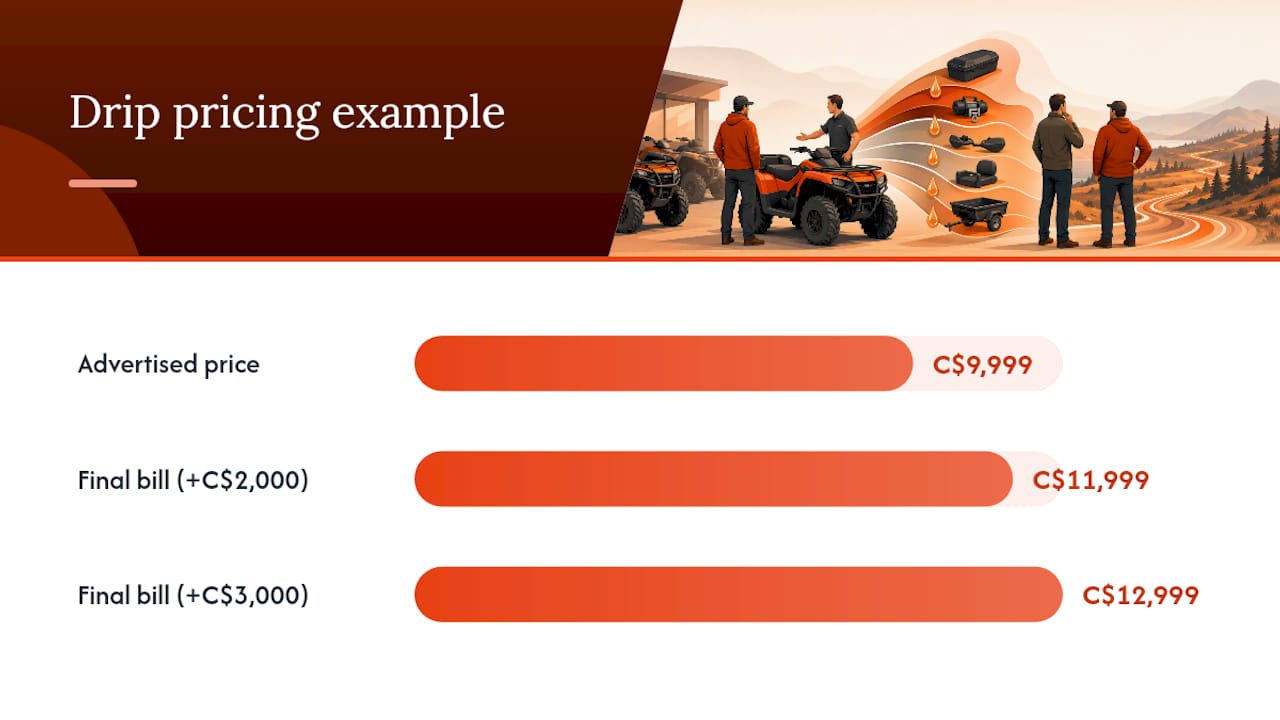
Ontario has gone further than most provinces by making all-in pricing a formal requirement. Under OMVIC’s all-in price advertising rule, any Ontario motor vehicle dealer advertising a price must include every fee it intends to collect from you, with exactly two exceptions: HST and licensing fees. Everything else, including freight, PDI, and admin charges, has to be baked into the number you see in the ad. If a dealer wants to charge those extras, they must show up itemized on the final bill of sale, not surprise you at the finance desk.
Other provinces don’t all have an identical rule on the books, but the principle behind it, that consumers deserve to see the real number before they commit, applies everywhere the Competition Bureau has jurisdiction, which is nationwide. A few things to keep straight when you’re comparing dealer claims:
- MSRP is the manufacturer’s suggested price, not a legal ceiling or floor.
- All-in pricing (where required) must exclude only HST and government licensing fees, nothing else.
- Drip pricing covers any mandatory, non-government fee added after the advertised price.
- Provincial coverage varies, so an Ontario-style guarantee doesn’t automatically exist in every province.
Pro Tip: If a listing price looks too clean, ask directly: “Is this the full out-the-door price before tax and licensing, or are there other fees coming?” A straight answer tells you a lot about how that dealer operates.
Which ATV Dealer Fees Are Mandatory, and Which Are Optional?
Some fees are baked into how the ATV gets to the floor. Others exist purely to pad the invoice, and a transparent dealer will let you decline them without a fight.
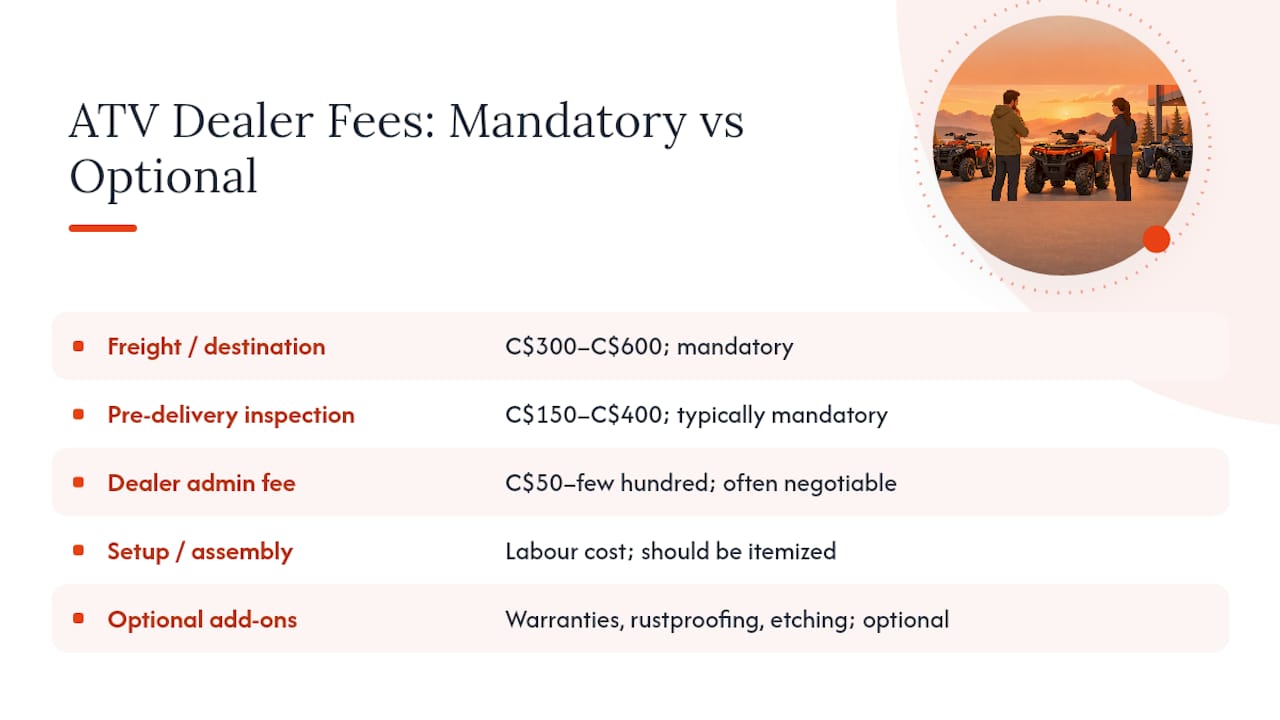
Freight or destination charge. This covers shipping the unit from the manufacturer to the dealership. It’s a real cost and one of the few line items that’s genuinely mandatory across the industry, though the amount should be disclosed up front, not sprung on you later. Buyer guides put typical freight charges somewhere in the C$300 to C$600 range, though it varies by model and distance from the distribution point, per ATVGo’s cost breakdown.
Pre-delivery inspection (PDI). This is the mechanical once-over every new ATV gets before it leaves the shop: fluid checks, torque specs, battery, lights, and a test start. It’s standard practice and typically mandatory, and reputable dealers treat it as part of doing business rather than a profit center. Ballpark cost tends to land in the C$150 to C$400 zone, again per ATVGo’s figures.
Dealer admin or documentation fee. This one is the most inconsistent fee in the entire industry. Some provinces cap it, some dealers waive it, and some pad it aggressively. It nominally covers paperwork processing, but it’s often just margin dressed up as a service charge. Realistic ranges run from C$50 to a few hundred dollars, and it’s worth asking directly whether it’s negotiable, because in many cases it is.
Setup or assembly fee. ATVs sometimes arrive partially disassembled and need final assembly before delivery. That’s a legitimate labor cost, though the amount charged should be disclosed on the itemized quote, not folded into a vague “admin” line.
Delivery fee. If you’re having the unit shipped to your address rather than picking it up, this is a real, often optional cost, and it should be quoted separately and clearly, not bundled into anything else.
Extended warranties, rustproofing, and etching. These are almost always optional add-ons pitched at the finance desk, not the sales floor. They get presented as if declining them is unusual or risky, which is a classic upsell tactic. You can say no to every one of them without affecting your ability to buy the machine.
The Competition Bureau has specifically flagged “processing” and “administrative” fees as common ambush charges that inflate advertised prices without adding real value, warning that hidden mandatory fees make honest price comparison nearly impossible across dealers, according to the Bureau’s own release on the topic. Combined, buyer guides suggest total out-the-door costs commonly run C$500 to C$2,000 above MSRP once every legitimate and questionable fee gets stacked together, per ATVGo. For a fuller Canadian breakdown of what a first year of ATV ownership actually costs once every fee is counted, Dirty Birdy’s own OTD cost breakdown walks through real numbers.
How Do You Get a Fair, Itemized Out-the-Door Quote?
Comparing dealers by sticker price alone is a losing game, because the sticker rarely reflects what you’ll actually pay. Comparing by out-the-door (OTD) quote is the only method that works, since it forces every dealer to show their full math on the same page.
-
Ask for a written OTD quote before you visit. Email or call and request the full price broken into MSRP, freight, PDI, admin fee, and any other charge, with HST and licensing shown as separate line items. A dealer that hesitates to put this in writing is telling you something.
-
Use a specific script with sales staff. Try this: “Can you send me an itemized quote that shows MSRP, freight, PDI, and admin fees separately, with tax and licensing broken out on their own line?” This phrasing removes wiggle room, because it names every category you expect to see.
-
Read the listing against the fine print. A headline price with an asterisk or a footnote reading “plus freight, PDI, and fees” is a signal the number you’re looking at isn’t the real one. Ontario dealers legally can’t do this under the all-in pricing rule, so if you’re shopping there and see it anyway, that’s worth flagging.
-
Collect at least two or three quotes using identical terms. Ask every dealer the same question in the same words, and request the same breakdown. Apples-to-apples only works if the apples are actually the same shape.
-
Watch for optional items disguised as standard. Extended warranties, etching packages, and rustproofing sometimes appear pre-checked on a quote sheet as if they’re part of the base deal. Ask specifically which line items you can remove, and confirm the removal doesn’t change the base price.
-
Push back at the finance desk if new charges appear. If a number changes between your written quote and the paperwork in front of you, stop and ask why before signing anything. A dealer genuinely operating at MSRP with no markup should be able to explain every discrepancy on the spot.
-
Know when to walk. If a dealer refuses to itemize, gets vague about fees, or tells you the “real price” only comes out once you’re sitting at the desk, that’s your answer. Walking away costs you nothing; signing a bill of sale you didn’t expect costs you real money.
Pro Tip: Screenshot every online listing and save every email quote before you go in person. If the numbers shift later, you’ll have a timestamped record showing exactly what was promised, which makes any dispute far easier to win.
OMVIC’s own consumer guidance backs this approach directly, advising buyers to confirm the full price early, scrutinize the bill of sale line by line, and walk away if a dealer won’t drop optional add-ons, according to OMVIC’s blog on breaking down the bill of sale. Dirty Birdy’s guide on avoiding dealer markups covers additional tactics for reading listings that hide the real number behind fine print.
What If a Dealer Adds Hidden Fees at Signing?
Stop before you sign. If a number on the bill of sale doesn’t match your written quote, you have the right to ask for time to review it, and no legitimate dealer will pressure you to sign on the spot rather than let you check the math.
At the dealership, ask specifically that any optional item, warranty, etching, rustproofing, be struck from the paperwork. Request a revised copy that matches your original quote, and if the finance officer resists, ask for a manager. You are not obligated to sign anything that afternoon, and a dealer who insists otherwise is showing you exactly the kind of pressure a transparent buying process should never involve.
Evidence matters more than memory once a dispute starts. Before you leave, make sure you have:
- Screenshots or PDFs of the original online listing and advertised price
- The written itemized quote you received by email or text
- Any follow-up correspondence confirming the numbers
- A copy of the actual bill of sale showing the discrepancy
With that paper trail, you have real options. You can file a complaint with the Competition Bureau if the dealer advertised a price it never intended to honor, since that’s precisely the drip pricing pattern the Bureau investigates. In Ontario, OMVIC accepts direct complaints against registered dealers, and its enforcement history includes real penalties. The Bureau has previously fined a national car rental company $700,000 for advertising unattainable prices, according to a past Competition Bureau enforcement case, so this isn’t a toothless process. Outside Ontario, your provincial consumer protection office is the equivalent contact point.
If the dollar amount in dispute is small, a formal complaint may resolve it. For larger discrepancies, especially where a signed bill of sale locks in an inflated price, small claims court becomes a realistic next step, and the evidence you collected at the dealership is exactly what that process will ask for.
What Does a Transparent Dealer’s Pricing Checklist Look Like?
Dirty Birdy Powersports sells CFMOTO ATVs, UTVs, and motorcycles at MSRP, with no markup added on top, and that pricing structure is the whole basis of how the dealership operates. It’s backed by more than 200 completed deliveries across Canada and a 5.0 Google rating, numbers that only hold up when the pricing behind them stays consistent from listing to bill of sale.
Here’s what that looks like in day-to-day practice, and what you should expect from any dealer claiming the same thing:
- The listed price on the website matches the number on the written quote, with no asterisk hiding extra charges.
- Freight, PDI, and any admin costs are itemized separately, not folded silently into a rounded-up total.
- Optional accessories or protection packages are presented as optional, with a clear yes-or-no choice, not pre-checked on the paperwork.
- Nationwide delivery pricing is quoted up front as its own line item, so a buyer in another province knows the full landed cost before committing.
- Staff can answer specific fee questions immediately, because they ride the machines they sell and know the actual cost structure, not just a script.
That last point matters more than it sounds. A sales team that actually uses the equipment tends to give straighter answers about setup, maintenance costs, and realistic total ownership costs, because they’re not reciting a brochure.
For readers who want to dig into the actual math before they shop, Dirty Birdy’s blog breaks down Canadian doc fees by province and explains freight and PDI charges in plain terms, useful reading whether or not you end up buying from Dirty Birdy specifically.
The Real Gap Between Legal Protection and Buyer Behavior
Regulators have done more of the heavy lifting here than most buyers realize. Between the Competition Bureau’s drip pricing enforcement and OMVIC’s all-in pricing rule, the legal framework already exists to stop dealers from hiding fees behind a low headline number. What’s missing isn’t law, it’s buyers actually using the tools those regulators handed them.
The conventional advice tells people to “shop around” and “negotiate hard,” which misses the actual leverage point. Negotiating a markup down still leaves you trusting a number that was inflated to begin with. Demanding a written, itemized OTD quote from every dealer you’re considering does something different: it exposes whether a markup exists at all, before you waste time haggling over one.
If you take one thing from this guide, make it this: price transparency isn’t a courtesy a dealer extends to you. It’s something you can require, in writing, before you ever discuss trade-ins or financing. Dealers who resist that request are telling you exactly what kind of deal you’re about to get.
— Dirty
Ready to Shop at MSRP With No Surprises?
Some dealers offer CFMOTO ATVs, UTVs, and motorcycles at MSRP with no markup added, ensuring consistent pricing from the website listing to the bill of sale.
When you request a quote, expect a written breakdown showing MSRP, freight, PDI, and any admin costs as separate line items, with HST and licensing shown on their own. Optional extras like warranties or accessories are offered, never pre-loaded, so you decide what goes on the final invoice. Delivery pricing should be quoted up front regardless of location. Browse current ATV, UTV, and motorcycle inventory and request your itemized out-the-door quote before you commit to any other dealer’s number.
Where to Verify These Rules and Dig Deeper
The Competition Bureau’s drip pricing guidance explains what counts as deceptive fee disclosure nationwide, and its hidden fees release lists common ambush charges to watch for. Ontario buyers should bookmark OMVIC’s all-in price advertising page, which spells out exactly what a dealer must include in an advertised price.
For market context, the Moto Canada 2025 report shows the scale of Canada’s ATV market and why transparent pricing matters at that volume. If you’re weighing whether to trade in an old machine before buying, UTV scrap value guidance covers what a used side-by-side might be worth. And for Canada-specific cost math, Dirty Birdy’s first-year ATV cost breakdown and guide on buying an ATV online with dealer-backed PDI go deeper than most general buying guides.
Sources
- Drip pricing – Competition Bureau of Canada
- All-in price advertising | OMVIC
- The ambush of hidden fees – Competition Bureau news release
- Moto Canada report shows powersports market normalizing – Powersports Business
FAQ
Can You Actually Buy an ATV at MSRP With No Markup in Canada?
Yes, some dealers genuinely sell at MSRP with no markup, but you have to verify it yourself rather than take a listing at face value. Ask for a written, itemized out-the-door quote and compare it against the sticker price before assuming a “no markup” claim is real.
What Dealership Fees Should You Watch Out For in Canada?
Freight, PDI, and dealer admin fees are the most common, and while freight and PDI are usually legitimate costs, admin fees vary widely and are often negotiable. Extended warranties, rustproofing, and etching packages are typically optional add-ons pitched at the finance desk, and you can decline all of them.
What Is the Cheapest Way to Buy an ATV in Canada?
There’s no single cheapest model, since pricing depends on engine size, brand, and features, but the biggest savings usually come from avoiding dealer markup entirely rather than chasing a specific budget model. Comparing itemized OTD quotes across several dealers, including ones that advertise straight MSRP pricing like Dirty Birdy Powersports, typically reveals bigger gaps than shopping by sticker price alone.
How Much Do Dealerships Typically Mark Up New ATVs?
There’s no fixed percentage, since markup depends entirely on the dealer, demand, and inventory, but combined fees and markup can push out-the-door costs C$500 to C$2,000 above MSRP according to industry cost breakdowns. The only way to know your specific markup is to compare the advertised price against a written itemized quote.
What Is the Top-Selling ATV Type in Canada?
Industry-wide sales data doesn’t break out one single best-selling model, but Moto Canada’s 2025 report recorded nearly 49,000 ATV units sold across the country that year, alongside strong side-by-side sales. That volume shows how much buying power Canadian riders collectively have, which is exactly why demanding transparent pricing matters at scale.