

Dealer fees on an ATV purchase in Canada are normal, but not all of them are fair game. Freight, PDI, and provincial taxes show up on nearly every deal and aren’t up for debate. Admin fees, setup charges, and market adjustments are dealer-set and often negotiable, sometimes down to zero. The fix is simple: ask for an itemized out-the-door quote before you sign anything, and question any line item the dealer can’t explain in plain terms.
TL;DR:
- Dealer-set fees like admin charges and market adjustments are highly negotiable, especially when itemized and challenged upfront.
- Freight, PDI, taxes, and registration are non-negotiable government charges, with ranges and rules varying by province.
- Comparing manufacturer’s build-and-price pages with dealer quotes helps identify double-billing or inflated fees, saving hundreds of dollars.
- Obtaining a written, itemized out-the-door quote before signing ensures transparency and highlights potential dealer markup on add-ons.
- Provincial regulators such as OMVIC and BC’s Vehicle Sales Authority provide enforceable disclosure standards that protect buyers from hidden costs.
Table of Contents
- What Do “ATV Dealer Fees” Actually Mean in Canada?
- Which ATV Fees Are Government-Required, and Which Are Dealer Choice?
- How Much Should ATV Dealer Fees Actually Cost?
- How Do You Get an Itemized Out-the-Door Price?
- What Does a Real ATV Out-the-Door Price Look Like?
- What a Transparent ATV Dealer Actually Looks Like
- Ready to Compare an Itemized Quote?
- Where to Verify Fees and Provincial Rules
- Sources
- FAQ
What Do “ATV Dealer Fees” Actually Mean in Canada?
Every quote you get from a powersports dealer breaks down into three buckets: the machine’s price, government charges you can’t avoid, and dealer add-ons that exist mostly to pad the bottom line. Sorting a quote into those three piles is the fastest way to figure out what you’re actually paying for.
Here’s a plain-language rundown of the fees you’ll run into, roughly ranked from “expect it” to “push back hard.”
- Doc/admin fee. This covers paperwork processing, and it’s almost entirely dealer discretion. Guides tracking dealer fees across Canada put this range at roughly $399 to $1,899, with outliers occasionally topping $1,500. There’s no federal or provincial standard amount, which is exactly why it’s the most negotiable line on the sheet.
- Freight/destination. This is the real cost of shipping the ATV from the factory or distribution center to the dealership. Some manufacturers fold it into the advertised MSRP; others list it separately. Either way, it’s a legitimate cost, not a markup, though the exact number is worth confirming.
- PDI (pre-delivery inspection) and dealer prep. A genuine PDI means someone actually inspected the machine, checked fluids, set up the battery, and made sure it runs before you take delivery. The problem: some dealers charge a separate PDI fee on top of an MSRP that already includes it. If freight and PDI show up as a single bundled number on the manufacturer’s own pricing page, and the dealer tacks on a second PDI charge, that’s double dipping.
- Dealer-installed accessories and setup fees. Windshields, mud flaps, hitch kits, whatever showed up on the lot model. If you didn’t ask for it, you shouldn’t be forced to pay for it. Ask the dealer to remove uninstalled or unwanted accessories from the bill before you agree to anything.
- Market adjustment / ADM (additional dealer markup). This is pure profit, tacked on when a model is in short supply or trending. It has no cost basis whatsoever. Treat any ADM line as 100% negotiable, and don’t be shy about asking why it exists.
- VIN etching. A theft deterrent that costs a dealer maybe $20 in materials and labor, often marked up to $150 to $300. Almost always removable if you push.
- Tire recycling and environmental levies. These are usually legitimate, government-mandated charges tied to provincial recycling programs, and they tend to be small (often under $20). The giveaway that something is legitimate versus invented: a real environmental levy will match a public provincial program, not a number the dealer made up on the spot.
The pattern across all of these: the closer a fee sits to actual manufacturer or government cost, the less room there is to negotiate. The closer it sits to pure dealer margin, the more you should push. Dirtybirdypowersports has written at length about how doc fees work across Canadian provinces, including which ones buyers have successfully gotten waived.
Which ATV Fees Are Government-Required, and Which Are Dealer Choice?
Here’s the dividing line that matters most: taxes and registration come from government, everything else comes from the dealer’s own pricing decisions.
Ontario and the Atlantic provinces use HST at 13% to 15% combined. British Columbia and Saskatchewan charge PST separately from GST. Alberta has no provincial sales tax at all, so an ATV buyer there pays only the 5% GST, which is one of the more overlooked cost advantages of buying in that province. None of this tax structure is negotiable, and no dealer can waive it.
Registration and licensing costs also vary by province and typically run somewhere in the range of $50 to $200, depending on whether the ATV needs a plate for road use or just an off-road registration. If you’re financing, expect a small lien registration fee, generally under $75, to record the lender’s interest in the vehicle. These are pass-through government charges, not dealer profit.
Where things get more interesting is disclosure law. In Ontario, dealers registered with the Ontario Motor Vehicle Industry Council are required to give buyers a full breakdown of the bill of sale, and OMVIC’s own guidance tells buyers to demand an itemized breakdown before signing so nothing gets buried in vague language. If a dealer refuses that request or insists a discretionary fee is somehow mandatory, that’s a real warning sign worth walking away from.
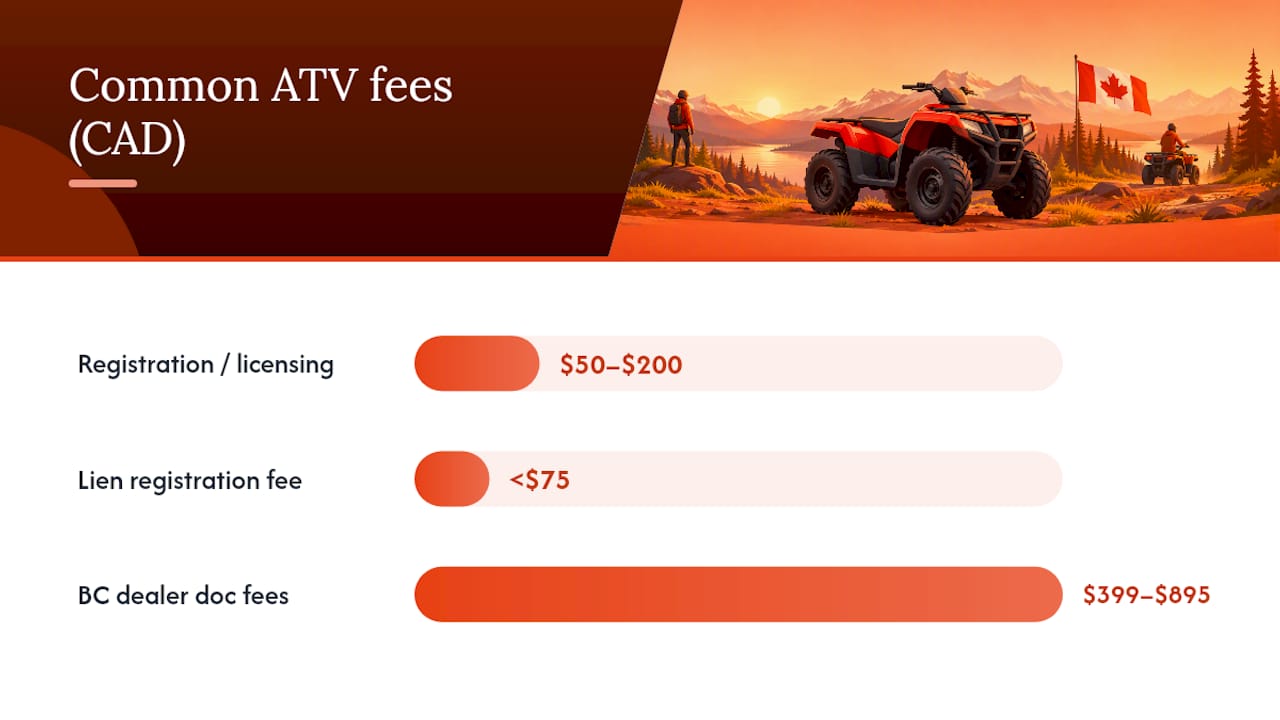
British Columbia works similarly under the Vehicle Sales Authority, which oversees dealer conduct and requires advertised pricing to reflect what a buyer will actually pay in many cases. BC buyers typically see doc fees land between $399 and $895, though there’s no hard cap written into law, so the range is a market norm rather than a ceiling. Quebec’s Consumer Protection Act gives buyers some of the strongest advertising and disclosure protections in the country, and industry fee guides note that Quebec and BC buyers generally have more leverage to challenge undisclosed charges than buyers in provinces with lighter regulatory frameworks.
Practically, this means:
- Ontario buyers can lean on OMVIC’s disclosure rules and file a complaint if a dealer misrepresents all-in pricing.
- BC buyers can point to VSA advertising standards when a quoted price balloons at signing.
- Alberta and Saskatchewan buyers fall under general consumer protection law and provincial motor dealer associations, which still require honest advertising even without a dedicated powersports regulator.
- Quebec buyers have some of the country’s toughest disclosure requirements to cite.
Knowing which regulator covers your province turns a vague complaint into a specific, cited request the dealer has to take seriously.
How Much Should ATV Dealer Fees Actually Cost?
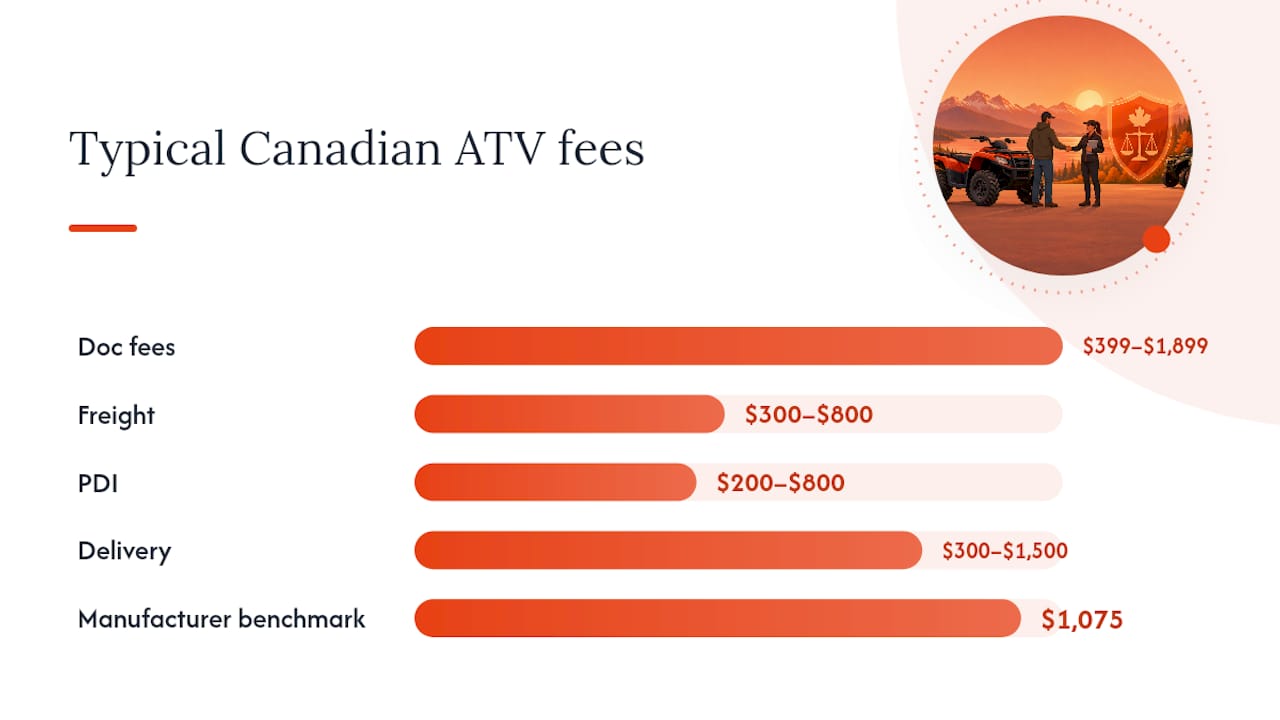
Freight typically runs $300 to $800, PDI $200 to $800, doc fees $399 to $1,499 or more, and delivery $300 to $1,500 depending on distance, according to fee breakdowns tracked across Canadian ATV dealerships. Those ranges give you a baseline to hold a dealer’s quote against.
Manufacturer pricing pages are the best reality check you have. Yamaha Canada’s build-and-price tool for the 2026 Grizzly EPS XT-R shows a combined freight, PDI, and fees line of exactly $1,075 baked into the total. If a dealer selling that same model quotes you a separate $600 PDI charge on top, you have documented proof of double-billing straight from the manufacturer’s own page.
Arctic Cat does something similar but calls it out differently: its pricing page for the Alterra 450 Limited lists a distinct Dealer Setup Fee of $450. That’s not hidden. It’s printed, which is exactly how a legitimate setup charge should behave, visible before you ever walk into a showroom.
Statistic Callout: Doc fees across Canadian dealerships commonly land in the $399 to $1,899 range, while manufacturer-published freight and PDI bundles, like Yamaha’s $1,075 example, give buyers a documented figure to compare against whatever a dealer quotes separately.
Then there are the outliers that exist purely to test whether you’re paying attention. Buyer discussions on ATV forums describe cases of dealers tacking on assembly or “prep” charges near $2,000 on small, budget-tier machines, sometimes more than the freight and PDI combined. There’s no manufacturer line item that justifies a number like that on an entry-level ATV. When a fee looks disconnected from the size or complexity of the machine, that’s your cue to ask for a manufacturer invoice comparison or simply move to another dealer.
How Do You Get an Itemized Out-the-Door Price?
Getting a real number means asking for a document that lists every single charge before you sign, not a verbal estimate at the sales desk.
- Request a full OTD quote in writing. It should list MSRP, freight, PDI, doc fee, any accessories, provincial tax, registration, and lien fees separately, not lumped into one “total due” number.
- Compare it against the manufacturer’s own pricing page. If the OEM site shows freight and PDI bundled at one figure and the dealer quotes a higher combined number, ask them to explain the gap.
- Challenge each discretionary line by name. Say something like, “I’d like the admin fee waived or reduced, since it doesn’t reflect an actual cost to you.” Dealers hear this often enough that a direct, calm ask works better than an emotional one.
- Use timing and competition as leverage. End-of-month and end-of-model-year deals tend to have softer fee structures because sales teams are chasing volume targets. A competing written quote from another dealership is the single strongest negotiating tool you have.
- Separate what’s fixed from what’s flexible. GST/HST, PST, registration, and lien fees are locked by law. Doc fees, setup charges, ADM, and VIN etching are not. Spend your negotiating energy where it can actually move the number.
- Watch how fees get rolled into financing. A dealer might offer to “wrap” a doc fee or accessory charge into your loan instead of removing it. That doesn’t erase the cost. It just spreads it across your payments with interest attached, which usually costs more over the loan’s life than paying it up front. If you’re financing, it’s worth reviewing how different finance package structures handle add-on costs before you agree to roll anything in.
Pro Tip: Ask for the OTD quote before you mention financing. Dealers sometimes hold discretionary fees firmer once they know you’re financing, because a bigger loan amount means more interest revenue for them too.
What Does a Real ATV Out-the-Door Price Look Like?
Numbers make this concrete faster than any explanation. Here’s a worked example using a mid-range utility ATV with an MSRP of $10,999, the kind of machine that shows up constantly in first-year ATV cost breakdowns for Canadian buyers.
| Line item | Full quote | With negotiable fees removed |
|---|---|---|
| MSRP | $10,999 | $10,999 |
| Freight/PDI | $1,075 | $1,075 |
| Doc/admin fee | $799 | $0 |
| VIN etching | $249 | $0 |
| Market adjustment (ADM) | $500 | $0 |
| Provincial tax (13% HST, example province) | $1,762 | $1,566 |
| Registration/plate | $110 | $110 |
| Total OTD | $15,494 | $13,750 |
Removing the doc fee, VIN etching, and ADM saves this buyer roughly $1,744 before financing even enters the picture. On a five-year loan at a typical powersports rate, that gap can add up to several hundred dollars more once interest gets applied to the padded amount. That’s the real cost of a “small” fee rolled into a payment plan instead of paid off or negotiated away up front.
What a Transparent ATV Dealer Actually Looks Like
Dirtybirdypowersports built its whole approach around the exact problem this article is describing: buyers showing up to a dealership and getting hit with fees they never saw coming. Selling at MSRP means there is no ADM line added.
Every quote includes freight, PDI, and any applicable taxes spelled out separately, the same standard OMVIC recommends buyers demand in Ontario. If you want to see what a dealer setup fee should actually include, ask us. We’ll walk through it before you commit to anything, not after.
Ready to Compare an Itemized Quote?
You’ve just read what an honest ATV quote should look like: freight and PDI spelled out, no invented admin markup, no market adjustment tax on demand. That’s the standard held on every unit sold, priced at MSRP.
If you’re shopping right now, pull up your local dealer’s quote and hold it next to ours. Request an itemized out-the-door price including delivery cost to your province, and see exactly where the numbers differ. Delivery is available nationwide, and the team can walk you through every line before you commit to anything. Browse current ATV, UTV, and side by side inventory and request your quote today.
Where to Verify Fees and Provincial Rules
For direct confirmation beyond what any dealer tells you, check OMVIC’s bill of sale guidance if you’re buying in Ontario, or BC’s Vehicle Sales Authority for advertising standards in that province. Manufacturer build-and-price pages, like Yamaha Canada’s, show you exactly what freight and PDI should cost before a dealer adds their own number. For registration specifics tied to your machine type, provincial transportation ministry sites list current lien and plate fees directly.
Sources
- Your guide to breaking down the bill of sale and all-in pricing in Ontario — OMVIC
- 2026 Grizzly EPS XT-R | Build & Price - Customize | Yamaha Motor Canada
- Hidden Dealer Fees Canada List 2026: 7 Shocking Costs to Refuse — RIDEZ
FAQ
What are the typical dealer fees in Canada?
Typical fees include freight (often $300 to $800), PDI ($200 to $800), and a doc/admin fee that commonly runs $399 to $1,899. Provincial sales tax, GST/HST, and registration are added on top and are set by law, not by the dealer.
Can you get rid of a doc fee?
Often, yes. Doc fees are dealer-set rather than government-mandated, and OMVIC’s guidance for Ontario buyers explicitly recommends demanding a full breakdown and questioning any charge the dealer can’t justify. If a dealer won’t budge or explain it, that’s often a sign to get a competing quote elsewhere.
What is the average price of a new ATV?
New ATV pricing in Canada varies widely by displacement and trim. Dirtybirdypowersports sells at MSRP with no markups, so the price you see reflects the manufacturer’s number, not an inflated dealer figure.
What is the difference between dealer invoice price and MSRP in Canada?
MSRP is the manufacturer’s suggested retail price, the number advertised to consumers and shown on build-and-price pages like Yamaha Canada’s. Dealer invoice is the wholesale price the dealer actually pays the manufacturer, which is typically lower and not usually disclosed to buyers, making MSRP the more reliable reference point for judging whether a quote includes a markup.