

Yes, most Canadian ATV dealers charge a documentation fee, and it’s a dealer-set line item, not a government one. It usually runs within a typical range of several hundred dollars and is negotiable more often than salespeople let on. Government registration and sales tax are separate charges entirely, set by your province, and they’re the part you actually can’t avoid.
TL;DR:
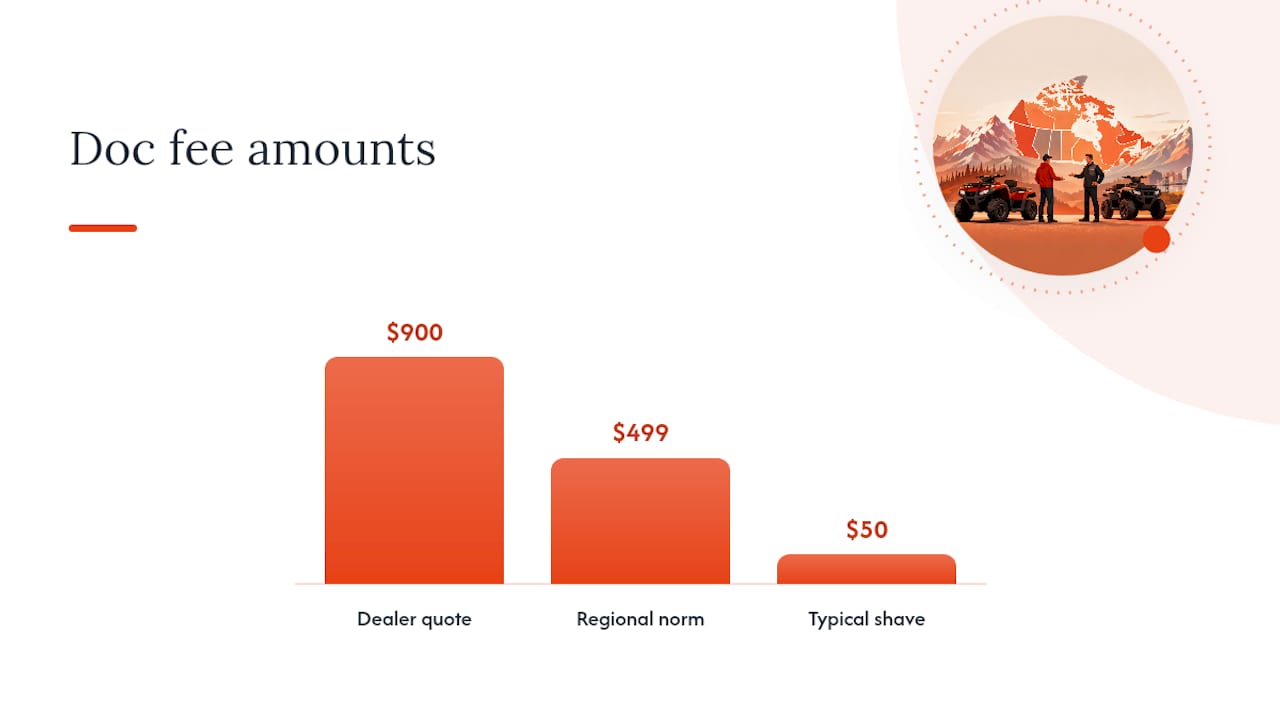
- Dealer-set documentation fees typically range from $300 to $900 and are negotiable, with many dealers charging around $499 regardless of ATV price.
- Proper registration costs are fixed by the government, such as $48 in British Columbia or $34.75 in Nova Scotia, and cannot be negotiated.
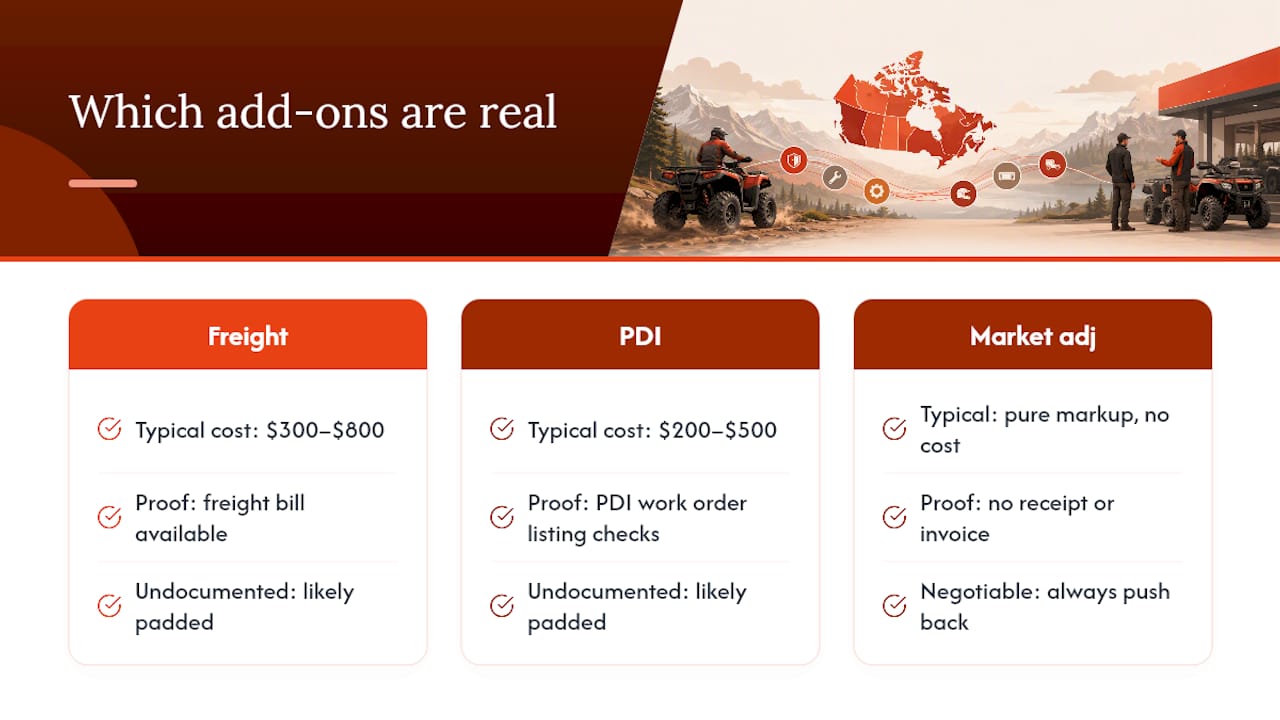
- Genuine freight and pre-delivery inspection costs are usually between $300–$800 and $200–$500 respectively, supported by documentation, unlike padded dealer markups.
- Always request an itemized breakdown of the doc fee and compare it to regional norms, proposing removal or a price reduction if the fee seems inflated or unsubstantiated.
- Regulatory bodies like Alberta’s AMVIC oversee dealer transparency; file a formal complaint if fees are not clearly disclosed or appear unfair.
Table of Contents
- What Is a Doc Fee on an ATV, and What Does It Cover?
- How Much Are ATV Doc Fees in Canada? Typical Ranges
- Government Fees vs Dealer Fees: What You Actually Have to Pay
- Is the Doc Fee Fair? How to Evaluate and Negotiate It
- Freight, PDI, and Market Adjustments: Which Add-Ons Are Real
- What to Do If a Dealer Won’t Disclose Fees or Charges Seem Unfair
- Dirty Birdy’s Take on Transparent Pricing
- A Buying Philosophy Worth Repeating
- Want an Honest Quote Before You Sign Anything?
- Sources
- FAQ
What Is a Doc Fee on an ATV, and What Does It Cover?
A documentation fee, sometimes written as “doc fee” or “admin fee” on your bill of sale, is what a dealer charges for the paperwork involved in getting your ATV sold, financed, and registered. It’s not a tax. It’s not a government requirement. It’s a line item the dealership invented, and the amount is entirely up to them.
Dealers typically point to a handful of tasks to justify the charge:
- Preparing and printing the sales contract
- Filing financing paperwork with a lender
- Registering the manufacturer’s warranty
- Filing a PPSA (Personal Property Security Act) notice if the machine is financed
- Preparing statutory declarations or lien searches
Some of that work is real. A PPSA filing costs the dealer a small fee, and warranty registration takes a few minutes of someone’s time. But none of it adds up to $500 in labor. According to a breakdown from Dealership Fees in BC, the actual administrative cost is usually far lower than the fee charged, meaning most of what you pay is margin dressed up as paperwork.
Before you sign anything, ask the dealer for an itemized breakdown of what the doc fee supposedly covers. If they can’t explain a specific task tied to a specific cost, that’s your signal the fee is mostly profit. A legitimate dealer will walk you through it without getting defensive.
How Much Are ATV Doc Fees in Canada? Typical Ranges
Doc fees on ATVs across Canada commonly land between $300 and $900, and quite a few dealers standardize around $499 regardless of the machine’s price, according to industry fee breakdowns from ATV Loan Canada. Freight charges typically run $300 to $800, and pre-delivery inspection (PDI) fees usually fall between $200 and $500.
By the numbers: A BC off-road vehicle registration certificate costs a flat $48 one-time fee, while Nova Scotia’s one-time OHV registration runs $34.75 plus annual permit renewals. Compare that to a $499 doc fee and you can see why separating government costs from dealer costs matters.
That gap is the whole point of understanding ATV registration fees in Canada before you walk into a showroom. Government charges are cheap and fixed. Dealer charges are flexible and often inflated.
Provincial registration costs you’ll typically see:
- British Columbia: $48 one-time certificate, ICBC plate or sticker required
- Nova Scotia: $34.75 one-time registration, plus annual permit renewal and small transfer fees
- New Brunswick and other provinces: modest fixed registration, plate, and transfer fees set by the provincial government
When you’re totaling up a dealer quote, split it into two columns. One column is government stuff: registration, GST, provincial sales tax where it applies. The other is dealer stuff: doc fee, freight, PDI, add-ons. The first column you can’t negotiate. The second column, you absolutely can.
Government Fees vs Dealer Fees: What You Actually Have to Pay
Not every line on an ATV invoice carries the same weight. Some charges are set by law. Others exist because the dealer decided to add them.
Mandatory charges you can’t avoid:
- GST (and provincial sales tax, where it applies to ATVs in your province)
- Provincial registration fees, like BC’s $48 certificate or Nova Scotia’s $34.75 one-time fee
- Plate, permit, or sticker fees tied to registration
Dealer-set charges that are open to discussion:
- Documentation or admin fees
- “Market adjustment” markups above MSRP
- Freight and PDI, in some cases
- Accessories or add-on packages bundled into the deal
One wrinkle worth knowing: provincial tax rules sometimes apply sales tax to freight and PDI charges even though those aren’t government fees themselves, because the province taxes the total sale price, not just the machine. That means a dealer padding freight or PDI doesn’t just cost you the padding, it costs you tax on the padding too. Always ask whether the tax is calculated before or after add-ons are applied.
This is also where financing gets murky. Lenders are required to disclose the full APR including fees, but dealer-arranged financing can carry its own charges layered on top of the doc fee, according to ATV loan guidance. Review the financing paperwork separately from the sales contract so you’re not double counting or missing a hidden lender fee.
Is the Doc Fee Fair? How to Evaluate and Negotiate It
Here’s a workable process to run through before you agree to anything:
- Ask for a written, itemized breakdown of the doc fee. Don’t accept “it’s just our standard fee.”
- Request receipts or work orders for anything tied to a real third-party cost, like a PPSA filing or a shipping invoice.
- Compare the total to typical ranges. If you’re being quoted $900 when the regional norm is closer to $499, ask why.
- Propose removal, not just reduction. Ask the dealer to drop the fee entirely rather than shave $50 off it.
- If they refuse to remove it, ask for an equivalent price cut elsewhere. Sales managers often find it easier to move the vehicle price than to touch a fee line, since the fee is treated as a fixed store policy.
- Time your negotiation. End of month or end of a sales quarter tends to give you more leverage, since dealers are often trying to hit volume targets.
- Bundle it. If the fee doesn’t move, ask for accessories, a service credit, or free delivery to offset it instead.
- Walk away if the dealer won’t discuss it at all. A shop unwilling to explain or adjust a discretionary charge is telling you something about how the rest of the transaction will go.
Pro Tip: Bring a printed copy of a competitor’s quote showing a lower or waived doc fee. Dealers respond faster to a number on paper than to a verbal complaint.
If a dealer flatly refuses to discuss the fee and won’t put anything in writing, that’s a bigger red flag than the fee itself. Reasonable dealers explain their pricing. Ones that get cagey usually have something to hide in the total.
Freight, PDI, and Market Adjustments: Which Add-Ons Are Real
Freight and PDI show up on almost every ATV invoice, and they’re not automatically a scam. Freight covers actually shipping the machine from the manufacturer or distribution point to the dealer, typically $300 to $800. PDI covers the technician time to assemble, inspect, and test the machine before delivery, typically $200 to $500.
The difference between a legitimate charge and a padded one comes down to documentation. Ask to see the actual freight bill or a PDI work order listing what was checked or adjusted. A dealer who can produce these documents is charging you for real work. One who can’t is likely charging you a number they picked because it sounds official.
“Market adjustment” fees are a different animal entirely. These are pure markup, usually applied when a model is in high demand, and they have nothing to do with cost. There’s no receipt to request because there’s nothing behind it except demand. These are always negotiable, and honestly, always worth pushing back on hard.
A quick way to sanity check any add-on: if the fee doesn’t correspond to a specific invoice, receipt, or documented task, treat it as negotiable margin rather than a real cost.
What to Do If a Dealer Won’t Disclose Fees or Charges Seem Unfair
Before filing anything, gather your paperwork: the signed contract, the full invoice breakdown, and any emails or texts where fees were discussed. Provincial regulators want documentation, not just a verbal complaint.
Where to go depends on your province. Alberta buyers can raise concerns with AMVIC, which oversees dealer conduct and required fee disclosures. Other provinces route complaints through their consumer protection offices or motor vehicle regulators. Most agencies will investigate undisclosed or misrepresented charges, though resolution timelines vary from a few weeks to a couple of months depending on the complexity.
- Collect the signed contract and full invoice
- Save all written communication with the dealer
- Identify your province’s regulator (AMVIC in Alberta, consumer protection offices elsewhere)
- File a written complaint with specifics, not general frustration
Dirty Birdy’s Take on Transparent Pricing
We sell CFMOTO ATVs and UTVs at MSRP, with no markups added at the counter. That’s not a negotiating tactic, it’s the starting price. Over 200 deliveries in and a 5.0 Google rating later, our approach has been to price the machine honestly and let the fee conversation stay simple, because there isn’t much to negotiate when the number was fair to begin with.
If you’re comparing quotes, request an itemized breakdown from every dealer you’re considering, including us. Put our numbers next to the ranges in this article and see how they hold up. We’d rather you check the math than take our word for it, and if you’re buying from outside BC, our team can walk you through what changes when you buy from an out-of-province dealer so registration doesn’t surprise you later.
A Buying Philosophy Worth Repeating
Buy from the dealer who shows you the math, not the one who tells you not to worry about it.
That’s really the whole philosophy. Every fee on an ATV invoice should be explainable in one sentence. If a salesperson can’t tell you what a charge covers, or gets uncomfortable when you ask, that discomfort is data. It tells you how the rest of the relationship with that dealer is going to go, especially if you ever need warranty work or a service issue resolved.
Print the checklists in this article. Bring them to the dealership. Ask the itemization question early in the conversation, before you’re emotionally attached to a specific machine sitting on the floor. The buyers who get burned on fees are almost always the ones who asked about price but never asked about the fees stacked on top of it.
— Dirty
Want an Honest Quote Before You Sign Anything?
Dirty Birdy Powersports prices CFMOTO ATVs and UTVs at MSRP, with no market adjustment tacked on and no mystery math on the doc fee line. That’s the real advantage here: you get one clean number to compare against everything else in this article, rather than a quote you have to reverse engineer at the kitchen table.
We offer delivery options to many locations, so this isn’t limited to buyers near Squamish, BC. If you’re shopping around, request an itemized quote from our dealership homepage and put it side by side with whatever your local dealer hands you. While you’re browsing, check out gear like the Braven Hellhound Uber XOR ATV/UTV radials or the ATV-UTV TEK Clearview center mirror to see the kind of straightforward pricing we apply across the whole catalog, not just the vehicles.
Sources
Check BC’s off-road vehicle registration page or Nova Scotia’s OHV registration page for official fees, and AMVIC for Alberta dealer-fee complaints. If you’re transferring a vehicle into Alberta, this vehicle transfer forms guide covers the paperwork involved.
- Registration for Off-Road Vehicles - Province of British Columbia
- Novascotia
- Understanding ATV Dealership Fees in Canada: What You Need to Know
- Extra fees - Alberta Motor Vehicle Industry Council (AMVIC)
- Dealership Fees in BC: What They Charge & What You Can Actually Negotiate
FAQ
Can You Get Rid of a Doc Fee?
Often, yes. Doc fees are dealer-set, not government-mandated, and many buyers successfully get them reduced or removed by asking directly or negotiating an equivalent price reduction instead.
Are Doc Fees Mandatory in BC?
No. Doc fees in BC are a dealer policy, not a legal requirement, which is why they vary so much between dealerships and why asking for a breakdown or a reduction is a reasonable request.
What Dealership Fees Should I Avoid in Canada?
Watch for unexplained “market adjustment” charges, doc fees above the typical $300 to $900 range without justification, and freight or PDI charges with no invoice or work order backing them up.
Do I Need Insurance to Register an ATV in Alberta?
Requirements vary by how and where you plan to ride, so confirm current rules with Alberta’s registration authority before purchase rather than assuming your existing vehicle policy carries over.
Loading…
Loading…