

MSRP is the manufacturer’s suggested retail price, quoted in Canadian dollars, for a specific model and trim. It’s a starting line, not the finish. Before you sign anything, ask the dealer for an itemized quote that separates MSRP from freight, PDI, dealer fees, and provincial tax, because the number on the manufacturer’s website almost never matches what you’ll actually pay at the till.
TL;DR:
- MSRP typically excludes freight, PDI, dealer fees, and provincial taxes, which can significantly raise the final out-the-door price depending on the region and dealer practices.
- Manufacturer websites in Canada often provide province-specific pricing that includes some fees but may not reflect local taxes or dealer discounts, making direct comparison essential.
- Comparing dealer quotes requires itemized breakdowns of all costs, as vague or bundled fees indicate markups that can inflate the final price beyond MSRP plus standard charges.
- Provincial taxes can vary widely, meaning a motorcycle’s total cost can differ by hundreds or thousands of dollars depending on the registration province and applicable levies.
- Currency fluctuations and model-year changes influence Canadian prices, with recent adjustments often lagging behind exchange rate shifts and affecting the value proposition for imported bikes.
Table of Contents
- Where to Find Official Motorcycle MSRP Listings in Canada
- What’s Baked Into MSRP and What Gets Added Later
- How Provincial Taxes and Fees Change Your Out-the-Door Price
- How to Compare Dealer Quotes and Catch a Markup
- Typical Motorcycle Price Ranges in Canada
- How the US-to-Canada Exchange Rate Affects Imported Motorcycle Prices
- From MSRP Research to Keys in Hand: A Realistic Timeline
- Buying at MSRP Isn’t a Slogan. It’s a Pricing Policy.
- Get a Straight, Itemized Quote From a Dealer That Sells at MSRP
- Sources
- FAQ
Where to Find Official Motorcycle MSRP Listings in Canada
Manufacturer websites are your first stop, and most Canadian brand sites now let you select your province before showing a price. Honda Powersports Canada, for instance, displays a “selling price” that folds in MSRP, freight, PDI, and applicable levies, but excludes sales tax and notes that some fees vary by dealer and province. Suzuki Canada goes a step further with a Price Summary breakdown tied to your selected province, though it also flags that dealers are independent businesses, free to sell for less (or charge differently).
Cross-checking matters just as much as the initial search. Yamaha Canada and other brands commonly use “starting at” language on motorcycle model pages, which usually means base trim, no accessories, and pre-tax pricing.
When you’re comparing numbers, capture these details every time:
- Exact model and trim (a base GSX-R750 and an upgraded version can differ by thousands)
- The currency and whether tax is included
- Which province the price selector was set to
- The date you pulled the number, since MSRPs shift with model-year changes
What’s Baked Into MSRP and What Gets Added Later
MSRP covers the bike itself. It typically does not cover freight (shipping the motorcycle from the factory or distribution center to the dealer), PDI or pre-delivery inspection (the dealer’s mechanical check and assembly before handoff), dealer administrative fees, destination charges, or any environmental levies your province applies to certain vehicles. Some brands blend these into one “all-in” or “selling price” figure. Others list MSRP alone and let the dealer tack on the rest, which is exactly where confusion creeps in.
Rebates and incentives complicate things further. A manufacturer might knock a few hundred dollars off MSRP during a seasonal push, but that discount usually shows up as a separate line on the quote rather than a change to the sticker price itself, so read every quote line by line instead of trusting the bottom number alone.
Here’s how to protect yourself:
- Ask for a written quote before you visit the dealership, not after you’ve fallen in love with a bike on the floor.
- Confirm whether freight and PDI are bundled or itemized separately.
- Ask specifically whether any rebate or incentive applies to your purchase and how it’s applied.
- Request the pre-tax and post-tax totals side by side.
Pro Tip: Save every quote as a PDF with the date attached. Dealers sometimes revise pricing week to week, and having a paper trail gives you leverage if a “limited time” offer mysteriously reappears a month later.
How Provincial Taxes and Fees Change Your Out-the-Door Price
The same motorcycle can cost meaningfully different amounts depending on which province you register it in, and taxes are the biggest reason why. Ontario, for example, charges HST, while Alberta has no provincial sales tax at all, and Quebec applies its own QST on top of GST. Registration and title fees vary by province too, and dealer fees aren’t standardized nationally.
Taxes and fees are the part buyers overlook most often, largely because manufacturer sites tend to advertise pre-tax numbers. Freight and PDI aren’t fixed nationally, either. They can shift by model size and by dealer, and some provinces layer on environmental levies for certain vehicle categories.
A workable formula for estimating your true cost looks like this:
- MSRP
- Plus freight and PDI (often C$800 to C$1,400 depending on the bike’s size)
- Plus dealer administrative fees
- Plus your provincial tax rate applied to that subtotal
- Plus registration and title fees (typically C$20 to C$150, depending on the province)
Freight, PDI, and registration fees vary by province and by dealer, which is exactly why a province selector on a manufacturer’s site beats a generic national price every time. If a model doesn’t offer that tool, your fastest route to an accurate number is a direct call or email to a local dealer asking for your province’s exact breakdown.
How to Compare Dealer Quotes and Catch a Markup
Comparing quotes only works if you’re comparing the same thing twice. Here’s the process that actually holds up:
- Lock down the exact configuration. Confirm model year, trim, color, and any factory-installed accessories before requesting a number. A base model and an “SE” trim aren’t interchangeable in a price comparison.
- Get everything itemized in writing. MSRP, freight, PDI, dealer fees, and taxes should each appear as their own line, not folded into one lump sum.
- Hold it against the manufacturer’s provincial MSRP. If Suzuki’s Price Summary for Ontario says one number and your dealer’s total runs hundreds higher with no clear explanation, ask why.
Watch for these red flags: a line labeled “market adjustment” (that’s a markup with a nicer name), fees described only as “dealer fee” with no explanation, quotes given pre-tax with no post-tax total, or accessories bundled in without individual pricing.
If a dealer doesn’t itemize, that’s information in itself. A price you can’t break down is a price you can’t trust. You’re allowed to ask for revisions, and you’re allowed to walk. Our guide to avoiding dealer markups covers negotiation tactics in more depth if you want to go further.
Pro Tip: Bring a printed copy of the manufacturer’s MSRP and provincial estimate to the dealership. It’s a lot harder for a salesperson to talk around a number you’re holding in your hand.
Typical Motorcycle Price Ranges in Canada
Entry-level motorcycles in Canada generally run in the low thousands to mid-thousands MSRP. Midrange bikes, the category most commuters and new riders land in, typically range from mid to higher thousands. Premium and touring models start above mid-thousands, sometimes well beyond once options are added.
Listing sites help calibrate expectations against real Canadian pricing. Shop a Ride shows new 2027 models with starting MSRPs like the Husqvarna 701 Enduro at roughly C$15,294, while Autotrader range from a 2016 Kawasaki Vulcan S around C$4,900 to a 2024 Royal Enfield near C$6,995.
Here’s a worked example for an entry-level bike with an MSRP in the lower thousands in Ontario:
- MSRP: base price
- Freight/PDI: typically several hundred to over a thousand dollars
- Dealer fee: varies by dealer
- Subtotal: sum of the above
- HST (13%): applies to the subtotal
- Registration: a typical provincial charge
- Estimated out-the-door price: total will vary accordingly
Run the same math on a C$12,000 midrange bike and freight/PDI alone can add C$1,200, before tax touches a cent. Every one of these numbers shifts by province and by dealer, so treat this as a planning exercise, not a quote. Always verify locally before you budget around it.
How the US-to-Canada Exchange Rate Affects Imported Motorcycle Prices
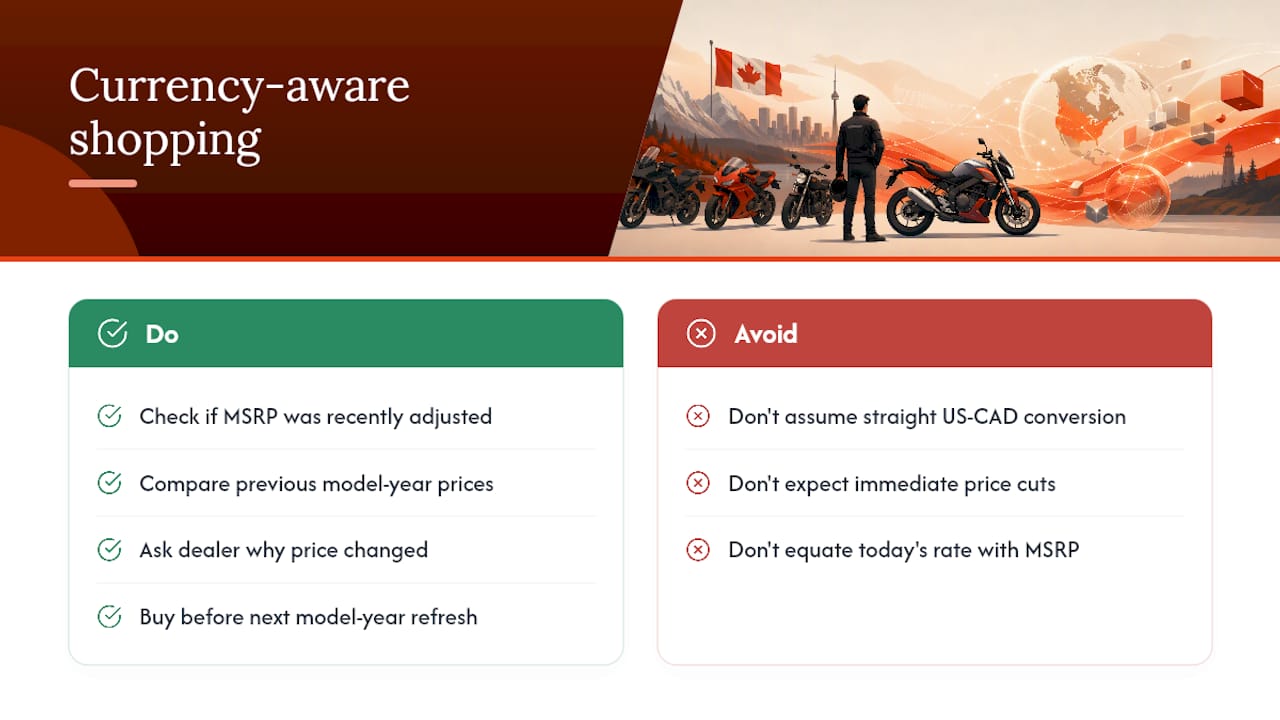
Most major motorcycle brands sold in Canada, Honda, Yamaha, Suzuki, Kawasaki, and others, are manufactured or priced through US or global parent operations, which means Canadian MSRP isn’t set in a vacuum. When the Canadian dollar weakens against the US dollar, manufacturers often adjust Canadian MSRP upward at the next model-year refresh to protect their margins in CAD terms. When the loonie strengthens, that pressure eases, though price cuts tend to lag behind currency gains rather than track them in real time.
This is one reason Canadian MSRP for a given model rarely matches a straight currency conversion of the US price. Manufacturers build in a buffer for import costs, distribution, and currency volatility, so you’ll often see a gap between “what the US price converts to today” and “what the Canadian sticker actually says.” That gap can widen or narrow depending on where the exchange rate sits when new model-year pricing gets locked in, typically months before the bikes hit Canadian showrooms.
For buyers, the practical takeaway is timing awareness rather than currency speculation. If you’re shopping a model that’s just had its Canadian MSRP updated, that price reflects exchange conditions from several months earlier, not today’s rate. It also explains why identical trims can jump a few hundred dollars from one model year to the next with no design or feature changes at all. If your budget is tight, asking a dealer whether a model’s MSRP was recently adjusted for currency reasons can tell you whether a similar bike from the previous model year offers better value.
From MSRP Research to Keys in Hand: A Realistic Timeline
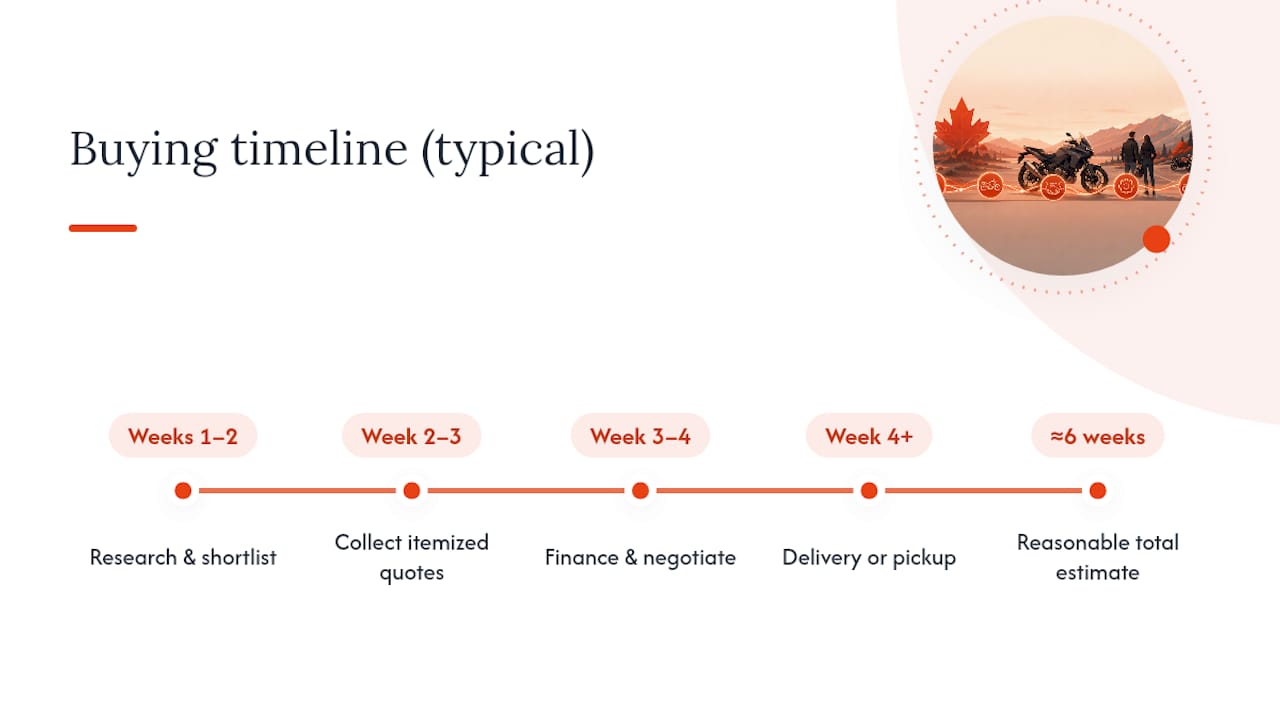
Buying a motorcycle in Canada rarely happens in a single afternoon, even when you already know what you want. Here’s roughly how it unfolds.
Weeks 1 to 2: Research and shortlisting. You compare MSRP across two or three models using manufacturer province selectors and cross-check against listing sites like Shop a Ride or AutoTrader.ca. This is also when you nail down your realistic total budget, MSRP plus freight, PDI, fees, and tax, not just the sticker number.
Week 2 to 3: Quote collection. You contact two or three dealers, request itemized written quotes, and compare them against your researched MSRP baseline. This is the stage where markups and vague fees tend to surface, so don’t skip it even if the first quote looks fine.
Week 3 to 4: Financing and negotiation. If you’re financing, this is when rates and terms get locked in alongside the final price. Our motorcycle financing guide walks through how monthly payments interact with your all-in price. Negotiation, if there’s room for it, typically happens here too.
Week 4 onward: Delivery or pickup. Local pickup can happen within days of a signed deal. Nationwide delivery, increasingly common for buyers outside major dealer hubs, usually adds one to two weeks depending on distance and carrier scheduling.
Six weeks total is a reasonable estimate for a first-time buyer doing it right. Rushing any stage, especially quote comparison, is where most people end up paying more than MSRP without realizing it.
Buying at MSRP Isn’t a Slogan. It’s a Pricing Policy.
Most of what goes wrong in motorcycle buying happens in the gap between “advertised price” and “actual invoice,” and that gap exists because it benefits the seller, not the buyer. Some dealerships sell CFMOTO ATVs, UTVs, and motorcycles at MSRP with no markups, which sounds simple until you realize how few dealerships actually commit to it in writing.
A few habits we’d pass on to any buyer, regardless of where you shop: always request an itemized quote before you get emotionally attached to a bike. Confirm the full delivery cost upfront if you’re buying outside your local area, not after the deal is verbally agreed. And check recall status and warranty terms before final payment, not after you’ve ridden it home.
One nuance worth flagging: if a dealer’s price runs above MSRP because of a genuine factory accessory package or dealer-installed upgrade, that’s a legitimate difference, not a markup. The line matters, and any dealer should be able to explain it clearly.
— Dirty
Get a Straight, Itemized Quote From a Dealer That Sells at MSRP
Most of the dealers you’ve been comparing quotes against build some cushion into their number, whether it’s a vague “dealer fee” or a “market adjustment” line that has nothing to do with actual market conditions. Some dealers skip that entirely, selling certain CFMOTO ATVs, UTVs, and motorcycles at MSRP with no markups.
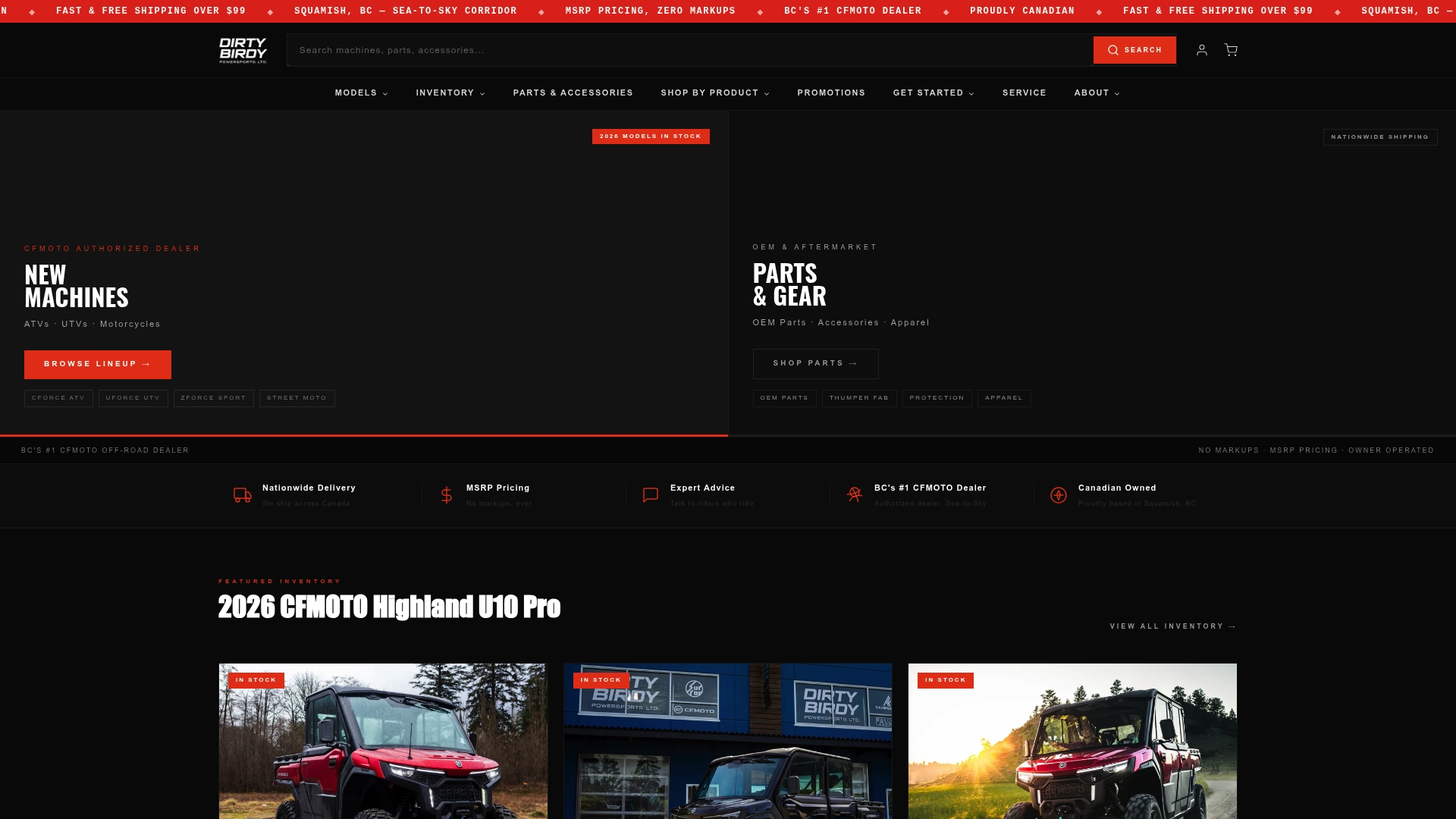
When you request a quote, ask for the same breakdown this article walked you through: MSRP, freight and PDI, dealer fees, applicable provincial tax, and delivery cost if you’re outside Squamish, BC. Delivery options may be available for buyers across Canada, though availability and pricing can vary by dealer location. If you’re shopping accessories or apparel alongside a new machine, browse the Dirty Birdy Powersports catalog or start with a quote request on a specific model to see exactly how the numbers break down before you commit to anything.
Sources
- Honda Street Motorcycles & Bikes: Touring, Cruisers, Sport, Adventure, Mini Moto | Honda Powersports Canada
- Autotrader
- New & Used Motorcycles for Sale in Canada | Shop a Ride
- Why do Canadians pay tax on used motorcycles? — Joe Rocket blog
FAQ
How much do motorcycles cost in Canada?
Entry-level models generally run in the lower to mid-thousands MSRP, midrange bikes typically fall in the mid to higher thousands, and premium or touring models start above the mid-thousands. Your out-the-door price adds freight, PDI, dealer fees, and provincial tax on top of whichever range applies.
What is the cheapest new motorcycle in Canada?
Genuinely new bikes at C$5,000 or under are rare and usually limited to mini-moto or scooter-class vehicles. For that budget, used-bike marketplaces like AutoTrader.ca are a far more realistic source, with used models regularly listed around C$4,900 to C$6,995.
Is 600cc too much for a beginner?
It depends more on the bike’s power delivery and weight than raw displacement. Some mid-thousand-dollar sportbikes are aggressive enough to overwhelm new riders, while others in cruiser or standard configurations are perfectly manageable for someone just starting out.
What motorcycle can I buy for $5,000?
At C$5,000, you’re almost entirely in the used market, where listings like a 2016 Kawasaki Vulcan S at roughly C$4,900 show what’s realistically available. New bikes at that price point are uncommon outside the smallest displacement categories, so most C$5,000 buyers should plan on shopping used inventory rather than new MSRP listings.
What does MSRP actually mean for a motorcycle purchase in Canada?
MSRP is the manufacturer’s suggested retail price for a specific model and trim, quoted in Canadian dollars, before freight, PDI, dealer fees, and provincial tax are added. Dealers like Dirty Birdy Powersports that sell at MSRP with no markups still add these standard charges, but nothing beyond the manufacturer’s baseline price.