

Pick the dealer when your vehicle is under warranty, subject to a recall, or needs manufacturer software programming. Pick a well-vetted independent shop for routine maintenance and most out-of-warranty repairs, where savings often run 20 to 30 percent per job. Keep every receipt and parts invoice either way. The right answer depends on the specific repair, not on brand loyalty.
TL;DR:
- Independent shops typically charge 20 to 30 percent less per repair compared to dealerships, especially on routine maintenance and out-of-warranty work.
- Warranty repairs are best performed at the dealer due to access to manufacturer-specific software, recall processing, and nationwide coverage at any location.
- Routine maintenance by qualified independents does not void your warranty, but recall work will usually need to be done at the dealership at no cost.
- Access to manufacturer software and updates remains limited for independents, particularly for encrypted modules and advanced driver-assistance system recalibrations.
- Maintaining organized service records from trusted shops enhances future resale value, regardless of whether the work was done by a dealer or an independent.
Table of Contents
- Dealer Service vs Independent Shops: Comparing Your Options
- How Much Can You Actually Save With an Independent Mechanic?
- Does Independent Service Void Your Warranty?
- How Do You Vet a Shop Before Committing?
- Which Should You Choose at Each Stage of Your Vehicle’s Life?
- What Makes Dirty Birdy Powersports a Credible Reference Point
- Does Service History Affect Resale Value?
- Who Has Access to Manufacturer Software and Updates?
- Does Your Insurance Care Where You Get Service?
- An Editorial Take on the Dealer Versus Independent Debate
- Where to Book Dealer-Backed Service and Get a Straight Answer
- Sources
- FAQ
Dealer Service vs Independent Shops: Comparing Your Options
The dealer service vs independent question isn’t really about who’s “better.” It’s about who’s better for the specific job sitting in front of you. Each side has real strengths that the other can’t easily match.
Dealership service departments run on factory-trained technicians who complete manufacturer-specific certification programs, often tied to ASE credentials plus brand-specific coursework. They plug directly into the OEM parts pipeline, which matters when a part is unique to your model year. Warranty repairs performed at one dealer typically carry nationwide coverage that lets you get reworked defects handled at any other dealer location, a real advantage if you drive across provinces or move. Dealers also process recalls directly, since they’re wired into the manufacturer’s technical service bulletin system.
The tradeoffs show up on the invoice and the clock. Dealer labor rates run higher, parts carry more markup, and service advisors sometimes push add-on work you didn’t come in for. Waits can stretch longer too, partly because approval for anything unusual often has to climb up to a branch manager or regional office before a technician can proceed.
Independent shops flip most of that. Labor costs less, owners can approve extra work on the spot instead of waiting on a chain of command, and a shop that knows your car over multiple visits tends to build a genuinely personal relationship with you.
Where dealers win:
- Factory training and brand-specific diagnostic experience
- Direct access to proprietary software and recall processing
- Warranty repairs honored at any location nationwide
Where independents win:
- Lower labor rates and more flexible parts sourcing
- Faster on-site repair authorization
- Personalized attention from the same technician visit after visit
The catch with independents: quality varies shop to shop, and some lack access to encrypted modules or rare legacy parts a dealer stocks by default.
How Much Can You Actually Save With an Independent Mechanic?
The numbers favor independents on almost anything routine. Dealer labor rates commonly run at least $30 an hour higher than what independent shops charge for the same work, and independents frequently price out 20 to 30 percent lower per repair incident than dealership quotes for equivalent service.
By the numbers: A $30+ hourly labor gap plus 20 to 30 percent lower per-incident pricing means the savings compound fast on any multi-hour job.
Run the math on two common jobs:
- A four-hour transmission repair. At a $30 hourly gap, that’s $120 in labor savings alone before parts markup differences even enter the picture.
- A 1.5-hour brake job. The labor difference is smaller in dollar terms, maybe $45, but percentage-wise it still lands in that 20 to 30 percent range once you factor in pad and rotor pricing.
Dealer pricing earns its keep when the job is warranty-covered or requires software programming only the manufacturer’s tools can perform. Outside those situations, treat every figure here as a range. Your brand, region, and the complexity of the specific repair all shift the numbers.
Does Independent Service Void Your Warranty?
No, and this is the single most persistent myth in the dealer service vs independent debate. Routine maintenance performed by a qualified independent shop does not automatically void your manufacturer warranty. A manufacturer has to demonstrate that the independent repair actually caused the failure being claimed. Simply proving you didn’t use the dealer isn’t enough grounds for denial.
Recalls work differently. Dealerships handle recall repairs, typically at no charge, because they’re the ones with direct pipeline access to the manufacturer’s technical bulletins and remedy parts. An independent shop generally can’t perform recall work even if willing.
To protect your coverage regardless of where you get service:
- Keep every receipt, parts invoice, and written service note.
- Ask for OEM part numbers on anything replaced.
- Request a written estimate before work begins, not after.
- Confirm whether the repair needs encrypted module access or software programming that only a dealer can perform.
How Do You Vet a Shop Before Committing?
Whether you’re looking at a dealer or an independent, the same short checklist applies. Start with your vehicle’s warranty status, since that alone eliminates half the decision. Then weigh job complexity, your parts preference, expected turnaround, and whether the shop will put a written warranty on its own repair work.
When you call or visit, ask these questions directly:
- What certifications does your technician hold, and is there brand-specific training on file?
- Do you have access to the manufacturer’s diagnostic software for my model?
- Where do your parts come from, OEM or aftermarket, and can I choose?
- What’s your labor rate, and how many hours are you quoting for this job?
- Is there a written warranty on the repair itself, separate from the parts warranty?
- Can you point me to recent customer reviews or references?
Independents vary widely in quality, so lean on certifications and a track record of long-term customer reviews to separate the strong shops from the shaky ones. Watch for red flags: refusal to give a written estimate, no verifiable reviews anywhere, vague or evasive answers about parts sourcing, or no warranty offered on completed work.
Pro Tip: When comparing two estimates side by side, line up the labor hours first, then the parts breakdown, then the warranty terms. A lower total price that skips the warranty line isn’t actually the cheaper option.

Which Should You Choose at Each Stage of Your Vehicle’s Life?
Your vehicle’s age and mileage should drive this decision more than habit or brand loyalty.
New or still under warranty: Default to the dealer for anything tied to warranty coverage, recalls, or software updates. For repairs that fall outside warranty terms, it’s reasonable to get a second opinion from an independent before authorizing dealer work.
Midlife, roughly 2 to 8 years old: This is where a hybrid approach pays off: dealer for complex diagnostic work or anything requiring proprietary tools, independent for oil changes, brakes, and routine maintenance.
High-mileage or long-term ownership: A well-vetted independent shop usually delivers the best value over time, especially once factory warranty coverage has expired entirely.
Mapped by job type: ADAS calibration and software updates lean dealer, transmission work depends on warranty status, oil changes and brake pads lean independent almost every time.
What Makes Dirty Birdy Powersports a Credible Reference Point
Dirty Birdy Powersports operates as a powersports dealership with a strong reputation based on transparent, no-markup pricing.
- Dealership status backed by manufacturer training and direct parts access
- A public track record across 200+ deliveries, not a handful of cherry-picked reviews
- Published resources on warranty-safe delivery and pre-delivery inspection procedures
Those proofs map directly onto the checklist above: verifiable reviews, documented process, and clarity on what dealer service actually includes. If you’re weighing dealer service for a powersports machine specifically, Dirty Birdy’s dealership page is a factual starting point, not a sales pitch.
Does Service History Affect Resale Value?
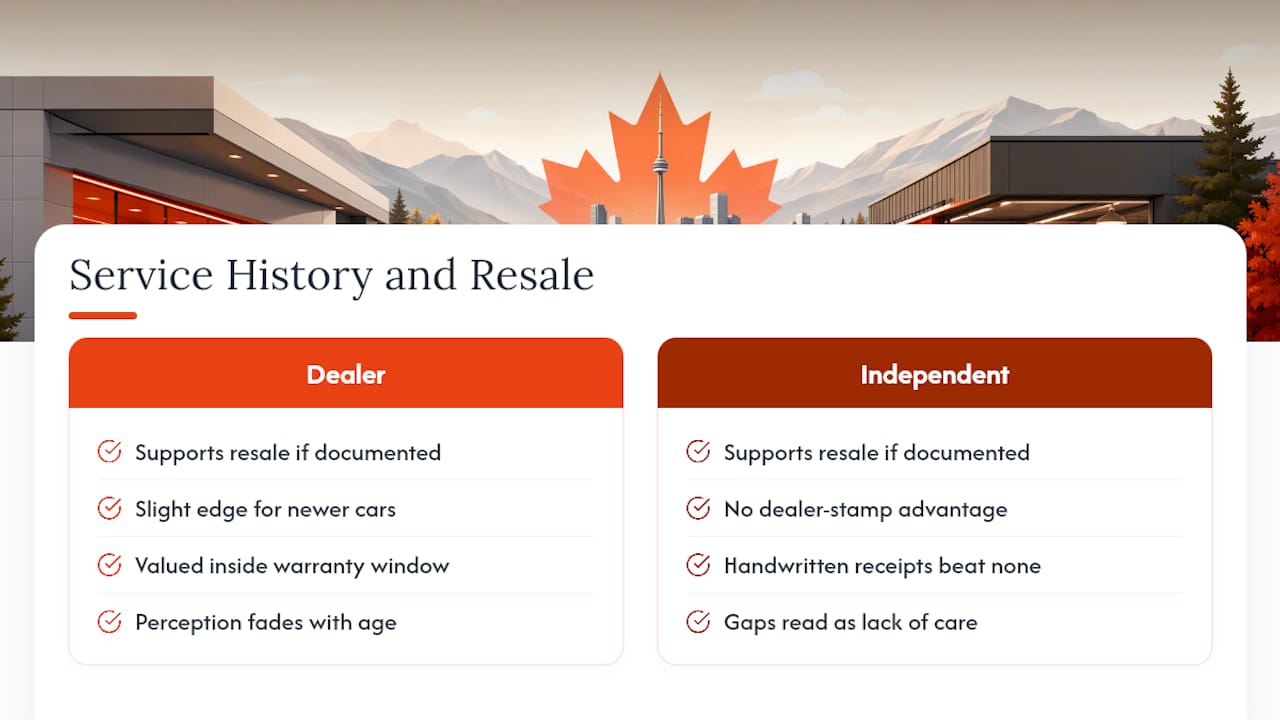
Documented service history at either a dealer or a reputable independent shop tends to support resale value more than the specific type of shop does. What buyers and appraisers actually look for is a complete, verifiable paper trail: dated invoices, itemized parts, and consistent intervals that match the manufacturer’s recommended schedule.
Dealer service records carry a slight edge in one specific scenario: private buyers and some dealers doing trade-in appraisals give extra weight to a fully dealer-stamped maintenance book, particularly on newer vehicles still inside their factory warranty window. That perception fades with age. On a vehicle past the 8 to 10 year mark, appraisers care far more about whether records exist at all than about which shop’s logo is on them.
Where independent service can actually hurt resale is when records are incomplete or missing entirely. A gap in documentation reads as a gap in care, regardless of where the work happened. A shoebox of handwritten receipts from a good independent shop is worth more to a buyer than no records from a dealer.
The practical takeaway: consistency and documentation drive resale value, not the sign on the building. If you split service between a dealer and an independent across your ownership, keep both sets of records together and organized. A buyer evaluating two similar vehicles will almost always favor the one with the clearer history, whichever shop performed the work.
Who Has Access to Manufacturer Software and Updates?
Dealers hold the clearest advantage here. Manufacturers restrict certain diagnostic and programming tools to authorized dealer networks, particularly for encrypted control modules, ADAS calibration, and firmware updates tied to safety systems.
That said, the gap has narrowed for routine diagnostics. Independents can source OEM parts through distributors and often match dealers on availability for current-generation vehicles, and many well-equipped independent shops now carry generic OBD-II scan tools capable of reading most fault codes. Where independents still fall behind is proprietary software that requires a direct manufacturer license, the kind used for module replacement or advanced driver-assistance recalibration after windshield or bumper work.
If your repair touches anything electronic beyond basic diagnostics, ask the shop directly whether they have manufacturer-licensed software access before you commit. An honest independent shop will tell you upfront when a job needs to go to a dealer instead of guessing and hoping the fix holds.
Does Your Insurance Care Where You Get Service?
Your insurer generally doesn’t dictate whether you use a dealer or an independent for routine maintenance, but a few situations change that calculus. After an accident, insurance-covered collision repairs often route through the insurer’s preferred shop network, which may or may not include the dealer, and choosing a shop outside that network can sometimes mean paying the difference out of pocket.
Comprehensive and mechanical breakdown claims work differently from maintenance decisions. If a covered failure happens and you’re filing a claim, the repair facility you choose, dealer or independent, needs to document the failure thoroughly enough to satisfy the adjuster. This is another place where the receipts-and-invoices habit pays off twice: once for warranty protection, once for insurance claims.
Extended warranty and vehicle service contracts sometimes carry their own network restrictions, separate from your regular insurance policy. Read those contracts before you assume either option is automatically covered.
An Editorial Take on the Dealer Versus Independent Debate
There’s no universal winner here, and pretending otherwise does readers a disservice. A cracked transmission on a two-year-old vehicle still under warranty belongs at the dealer, full stop. A brake job on a ten-year-old daily driver belongs at a trusted independent that’s earned your business over several visits. The real skill isn’t picking a side. It’s asking the right questions before you commit, and keeping the paperwork that protects you either way.
— Dirty
Where to Book Dealer-Backed Service and Get a Straight Answer
If you’d rather skip the guesswork on warranty-safe procedures, Dirty Birdy Powersports offers dealer service backed by manufacturer training, documented invoices, and the same no-markup transparency the dealership applies to vehicle sales.
Certified technicians handle CFMOTO ATVs, UTVs, and motorcycles with full access to manufacturer diagnostic software, so recalls and warranty work get processed correctly the first time. Every repair comes with a written invoice you can add to your own service file, the same documentation habit this article recommends regardless of which shop you use. Dirty Birdy also ships parts and accessories, including tires like the Braven Bloodaxe R/T Hybrid Premium radial, nationwide for owners who prefer to source OEM-compatible parts directly.
This isn’t a claim that dealer service beats every independent shop on every job. It’s one legitimate, documented option. To book service or ask about parts availability for your machine, visit Dirty Birdy Powersports directly.
Sources
- Corner Garage vs. Dealer Service Department
- OEM dealer vs independent service provider: Which is right for your office?
- Should a Car Be Serviced at a Mechanic or Dealership?
FAQ
Is It Worth Getting Service Done at the Dealership?
It’s worth it for warranty work, recalls, and anything requiring manufacturer software programming. For routine maintenance outside warranty, an independent shop usually saves you money without sacrificing quality.
What’s the Smartest Way to Pay for Vehicle Service?
Get a written estimate before authorizing any work, and pay by a method that gives you dispute protection, like a credit card, rather than cash. Keep every invoice regardless of payment method.
What Shouldn’t You Say to a Dealer or Shop?
Avoid announcing your maximum budget or that you “need it fixed no matter the cost.” Ask for an itemized estimate first and negotiate from that, rather than signaling how much you’re willing to pay upfront.
What Are the Four C’s in Automotive Service?
Definitions vary by source and context, and there’s no single standardized version specific to service decisions. Ask any shop directly to explain their own repair philosophy rather than assuming a universal framework applies.