

CFMOTO is a genuinely reliable brand for most U.S. buyers, but the ownership experience depends heavily on two things you control: how close you are to an authorized dealer and how seriously you treat the maintenance schedule. The machines are mechanically sound, the KTM engineering partnership raised the bar on upper-displacement engines, and long-term owners report trouble-free riding to 7,000–10,000 miles as the norm, with a meaningful subset reaching 20,000–50,000+ miles on consistent maintenance. The main friction points are fit-and-finish on earlier models, parts lead times in regions with thin dealer coverage, and steeper depreciation than established Japanese brands. If you go in with clear eyes on those tradeoffs, CFMOTO delivers real value.
Three things to lock in before you ride:
- At delivery: Inspect fasteners, check for oil seepage around the filter, and confirm the dealer has performed and documented the pre-delivery inspection.
- Maintenance mindset: Treat the first 3,000-mile service as non-negotiable. Early oil changes and valve checks are what separate the owners who hit 50,000+ miles from those who don’t.
- Dealer proximity: If the nearest authorized service center is more than an hour away, factor parts wait times into your risk tolerance before you buy.
Table of Contents
- Is CFMOTO reliable? What owners actually report
- How model years and the KTM partnership changed CFMOTO quality
- What are the most common CFMOTO problems owners report?
- How does reliability differ across ATVs, UTVs, and motorcycles?
- Warranty, recalls, and parts support in the United States
- Maintenance and ownership practices that keep CFMOTO reliable
- What mileage and ownership costs should you realistically expect?
- How does CFMOTO compare with legacy brands on reliability?
- Why dealer choice and setup matter as much as the machine itself
- Should you buy a CFMOTO? A short decision framework
- Key Takeaways
- The dealer relationship is the part most buyers underestimate
- Dirtybirdypowersports makes the buying process straightforward
- Where to check facts and read more
Is CFMOTO reliable? What owners actually report
The clearest picture of CFMOTO durability comes from owner forums, Reddit threads, and Facebook groups, not manufacturer spec sheets. The aggregate pattern is consistent: most owners ride without major mechanical drama through the first several thousand miles, and those who follow the service schedule closely often push well beyond that without engine-level failures.
What does show up in owner threads, repeatedly, is a specific cluster of minor complaints. Small oil leaks, flaky trim pieces, and electronics or sensor quirks are the dominant themes, not blown engines or catastrophic drivetrain failures. That distinction matters because it changes the ownership calculus entirely. A leaking oil filter is a $15 fix. A cracked engine case is a $2,000 problem. CFMOTO owners mostly deal with the former.
Parts availability is where the experience diverges most sharply between owners. Riders near a well-stocked authorized dealer describe a smooth ownership experience. Those in rural areas or regions with sparse dealer networks report waiting weeks for basic components, which turns a minor repair into a long downtime. Dealer proximity and parts lead times are the single biggest variable in how owners rate their overall experience.
How model years and the KTM partnership changed CFMOTO quality
The clearest inflection point in CFMOTO’s build quality is roughly 2018. Models from about 2018 onward show noticeably better materials, tighter assembly tolerances, and fewer early fit-and-finish complaints in owner reports and dealer writeups. Pre-2018 machines are not unreliable, but they carry a higher probability of the trim and minor-component issues that dominate negative reviews.
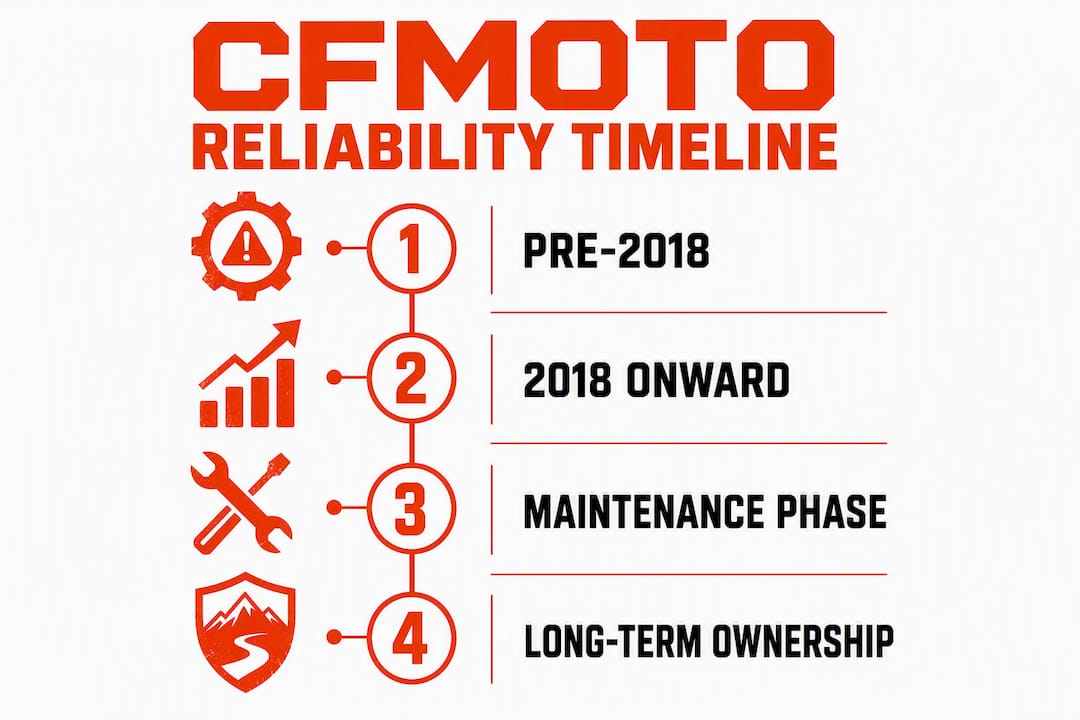
The KTM relationship is the most significant engineering signal in CFMOTO’s history. The collaboration led to shared engine platforms, including LC8c-derived powerplants, and brought KTM’s testing rigor into CFMOTO’s development process. The effect is most visible in upper-displacement models, where the engine architecture and quality control reflect European engineering standards rather than entry-level Chinese manufacturing norms. Lower-displacement and utility-focused models benefit less directly from the KTM influence, though the broader manufacturing culture shift post-2018 lifted quality across the lineup.
Practical buyer checklist for used or new shopping:
- Prioritize 2018 or newer models whenever possible.
- On used units, request documented service history. An owner who kept receipts is a better signal than low mileage alone.
- Check the VIN and model code to confirm the production year, since some markets received carryover inventory labeled as newer.
- For new purchases, ask the dealer which engine platform the model uses and whether it shares architecture with KTM-influenced designs.
What are the most common CFMOTO problems owners report?
Owner-reported issues fall into three clear tiers, and knowing which tier you’re dealing with changes how you respond.
Fit-and-finish (annoying, rarely expensive):
- Loose or rattling trim panels, especially on UTVs after hard use
- Paint inconsistencies and minor panel-gap variations on pre-2020 models
- Soft or imprecise switchgear feel compared with Japanese competitors
Serviceable mechanical quirks (fixable with basic tools or a shop visit):
- Oil filter leaks on certain middleweight motorcycle and ATV models. The factory filter on some units doesn’t seat with enough clamping force, and swapping to a premium aftermarket filter like a K&N resolves the issue permanently.
- Occasional sensor faults triggering warning lights, most of which clear after a reset or a connector re-seat.
- Fasteners that work loose on high-vibration areas (footpegs, skid plates, cargo racks on UTVs).
Warranty-level failures (less common, but they happen):
- Electronics module failures on early production runs of some models
- Fuel system irregularities on a small subset of units, typically caught during the first service
Pro Tip: At delivery, bring a flashlight and check the oil filter area and drain plug for any seepage before you sign off. Also run the machine through its full electronics suite: lights, display, any digital modes. Documenting any fault at delivery, in writing, protects your warranty claim if the issue resurfaces later.
How does reliability differ across ATVs, UTVs, and motorcycles?
The vehicle category shapes the failure pattern as much as the brand does. CFMOTO’s ATV, UTV, and motorcycle lines each carry a distinct reliability profile based on how they’re used and how their components are stressed.
| Category | Drivetrain reliability | Electronics / trim | Wear parts availability | Dealer dependency |
|---|---|---|---|---|
| ATV | Generally strong; occasional belt wear on CVT models under heavy load | Minor sensor faults; trim holds up well in utility use | Filters, belts, brake pads widely stocked | Moderate; many owners self-service |
| UTV | Good for recreational use; harder work-duty cycles accelerate wear on CV joints and differentials | More complex electronics; display and accessory wiring faults reported | Some specialty parts have longer lead times | Higher; complex repairs need authorized shop |
| Motorcycle | Strongest overall, especially KTM-influenced engines; oil filter and sensor quirks most common | Switchgear and instrument cluster complaints on pre-2020 models | Generally good for common items; specialty parts slower | Moderate; many riders comfortable with basic maintenance |
ATVs used for genuine work duty, like farm or trail-clearing applications, tend to show accelerated wear on CVT belts and brake components. That’s not a CFMOTO-specific problem; it’s physics. Budget for belt replacements if you’re running the machine hard. UTVs in the same work-duty role put more stress on CV joints and differentials, and those parts can have longer lead times than basic consumables. For riders upgrading suspension or drivetrain components on a UTV, heavy-duty replacement uniballs are worth considering proactively rather than waiting for a failure.
Motorcycles, particularly the upper-displacement models with KTM-influenced engines, show the best reliability-to-price ratio in the lineup. The engine architecture is proven, the service intervals are manageable, and the most common complaints are minor enough that a mechanically inclined rider can handle them at home.
Warranty, recalls, and parts support in the United States
CFMOTO’s standard warranty for U.S. buyers covers the powertrain and major components, but the exact terms vary by model year and vehicle type. Always confirm the specific warranty length and coverage scope directly with the selling dealer before purchase, since promotional warranty extensions and model-specific terms are not always prominently advertised.
For recalls, the U.S. process is straightforward. The NHTSA recall lookup tool lets you search by VIN or make/model to check for any open safety recalls before you buy or after you take delivery. Running this check takes two minutes and should be non-negotiable for any used CFMOTO purchase.
Buyer verification checklist:
Confirm the exact warranty duration and what it covers (powertrain, electronics, frame) with the dealer in writing. Ask specifically whether the warranty is transferable if you buy used. Check NHTSA for open recalls on the specific VIN. Ask the dealer for their average parts lead time on common components for your model. Request a documented pre-delivery inspection checklist, signed by the technician. If the dealer can’t produce that documentation, that’s a signal about how they operate.
Parts support in the U.S. has improved as CFMOTO’s dealer network has grown, but regional gaps remain. Owners in major metro areas with multiple authorized dealers generally report acceptable wait times. Rural owners sometimes describe multi-week waits for non-consumable parts. If you’re in a thin-coverage area, ask the dealer upfront whether they stock common wear items for your specific model.
Maintenance and ownership practices that keep CFMOTO reliable
The owners who hit high mileage on CFMOTO machines share one common trait: they treat the maintenance schedule as a floor, not a ceiling. Here’s what the first 24 months should look like.
- Initial break-in (0–500 miles): Follow the manufacturer’s break-in protocol. Avoid sustained high RPM. Change the engine oil at the end of break-in, even if the interval hasn’t technically expired. This removes metal particles from initial wear.
- First service (around 3,000 miles): Oil and filter change, fastener torque check, brake fluid inspection, air filter check. This is the most important service interval on any CFMOTO. Dealer materials consistently cite this milestone as critical for long-term engine health.
- Ongoing oil changes (every 3,000 miles or per model manual): Use the viscosity grade specified in your model’s manual. Owners who switch to a premium synthetic early report fewer minor leak issues.
- Valve check (per model-specific interval, typically 6,000–12,000 miles): This is where many owners skip a step and pay for it later. Valve clearance drift is quiet until it isn’t.
- Spark plug replacement (per manual, typically 6,000–12,000 miles): Cheap insurance. A fouled plug causes rough running that owners sometimes misdiagnose as a fuel system problem.
- Electronics and firmware inspection (annually): Ask your dealer whether any software updates are available for your model’s ECU or display system. Some early fault codes are resolved by a firmware update, not a parts replacement.
- Brake pads and fluid (inspect every season): Brake fade from worn pads is a safety issue, not just a maintenance item. Fluid absorbs moisture over time; replace it every two years regardless of appearance.
- Air filter (every 3,000 miles or more frequently in dusty conditions): A clogged filter starves the engine and causes rich running. In dry, dusty riding environments, check it twice as often as the manual suggests.
Pro Tip: When you take delivery, ask the dealer to walk you through the firmware version on the display and confirm that all fasteners were torqued to spec during assembly. Get this in writing on the pre-delivery inspection form. It takes five minutes and gives you a documented baseline if anything comes loose in the first 500 miles.
What mileage and ownership costs should you realistically expect?
The honest mileage picture, drawn from owner reports, breaks into three phases.
Year one (0–7,000 miles): Most owners experience this stretch without significant mechanical issues. Minor fit-and-finish complaints surface here, and the oil filter leak issue, if it’s going to appear, usually shows up in the first few thousand miles. Budget for the initial service and one or two small fixes.
Years one through five (7,000–30,000 miles): This is where maintenance discipline separates the good experiences from the bad ones. Owners who stay on schedule report continued trouble-free running. Those who stretch oil changes or skip valve checks start seeing rough running, sensor faults, and occasionally more serious wear. Annual maintenance costs in this range, covering oil, filters, brake pads, and a tire set, typically run in the hundreds of dollars per year depending on riding frequency and style. Tires are one of the larger recurring costs; quality ATV/UTV radials like the Braven Hellhound Uber XOR are worth the investment over budget options that wear faster and perform worse in variable terrain.
Five-plus years (30,000–50,000+ miles): A subset of owners reaches this range, and they’re almost universally the ones who treated maintenance as a priority from day one. At this mileage, expect to address wear items like wheel bearings, CV boots, and potentially a clutch or belt depending on use. These are normal high-mileage costs on any brand.
On depreciation: owner anecdotes and forum posts consistently describe lower trade-in offers and faster value loss compared with established Japanese brands. If resale value matters to you, CFMOTO is not the strongest choice. If you plan to ride it until it’s worn out, the lower entry price more than compensates for the depreciation curve.
How does CFMOTO compare with legacy brands on reliability?
The comparison that matters most isn’t “is CFMOTO as reliable as Brand X?” It’s “what am I trading to get the price advantage?”
Comparing CFMOTO to legacy manufacturers often misses the core point: CFMOTO’s value proposition is competitive features and pricing, and that implies a more active ownership role. Established Japanese manufacturers have decades of parts infrastructure, dense dealer networks, and resale markets that CFMOTO simply hasn’t built yet in the U.S. That’s not a quality indictment; it’s a maturity gap.
For a buyer who is mechanically comfortable, lives within reasonable distance of an authorized dealer, and is buying primarily on features-per-dollar, CFMOTO is a strong fit. The KTM-influenced engines in upper-displacement models are genuinely competitive on engineering quality, and the post-2018 build improvements close much of the fit-and-finish gap that defined the brand’s earlier reputation.
For a buyer who wants the lowest possible ownership friction, values a deep used-parts market, or needs a machine that holds resale value, established Japanese or European manufacturers remain the safer choice. The friction isn’t necessarily about mechanical failure. It’s about parts wait times, dealer density, and the resale market being thinner.
The honest framing: CFMOTO is a brand that rewards engaged owners. Passive ownership, where you ride it and expect it to handle itself, produces worse outcomes than it would on a brand with a 40-year U.S. dealer infrastructure.
Why dealer choice and setup matter as much as the machine itself
The single most controllable reliability variable in CFMOTO ownership isn’t which model you buy. It’s who assembles and sets it up.
Authorized dealers who perform correct pre-delivery inspection and first-service work dramatically reduce the early “teething” complaints that dominate negative owner reviews. Most of the fit-and-finish and minor mechanical issues that show up in the first 1,000 miles are assembly-related, not manufacturing defects. A dealer who torques fasteners correctly, seats the oil filter properly, and runs the machine through its full electronics check before handing over the keys eliminates a large share of the problems that end up in forum complaint threads.
Dirtybirdypowersports has completed over 200 deliveries with a 5.0 Google rating, and the pattern across those deliveries is consistent: buyers who receive a properly documented pre-delivery inspection and a clear first-service schedule report far fewer early issues than those who take delivery from dealers who treat PDI as a formality.
What to confirm at delivery: Ask for the signed PDI checklist. Confirm the firmware version on the display. Check that the oil filter is hand-tight plus a quarter turn, not over-torqued. Get the first-service date in writing, and ask whether the dealer stocks common wear parts for your specific model. A dealer who can answer all of these questions without hesitation is a dealer worth buying from.
Should you buy a CFMOTO? A short decision framework
The decision comes down to three variables: use case, dealer proximity, and maintenance willingness.
Buy new with confidence if you’re within a reasonable distance of an authorized dealer, you’re comfortable following a maintenance schedule, and you’re buying primarily on features-per-dollar rather than resale value. The post-2018 lineup, particularly KTM-influenced motorcycle and upper-displacement ATV models, represents genuine value at the price point.
Buy used carefully. Prioritize 2018 or newer, insist on documented service history, run the NHTSA VIN check, and have an authorized dealer inspect it before purchase. A well-maintained used CFMOTO is a good buy. An unmaintained one is a gamble.
Skip CFMOTO if you’re in a region with no authorized dealer within a practical distance, you want a machine that holds resale value, or you prefer a brand with a 30-year U.S. parts infrastructure behind it. Those are legitimate priorities, and there are better options for that buyer profile.
For the typical U.S. buyer who wants a capable, feature-rich machine at a fair price and is willing to stay on top of maintenance: CFMOTO is a solid buy. Go in with realistic expectations, choose your dealer carefully, and the machine will reward you.
Key Takeaways
CFMOTO is mechanically sound for most U.S. buyers, but long-term reliability depends on dealer quality, maintenance discipline, and realistic expectations about parts availability and resale value.
| Point | Details |
|---|---|
| Overall verdict | CFMOTO is reliable for engaged owners near authorized dealers; passive ownership in thin-dealer regions produces worse outcomes. |
| Model-year matters | Post-2018 models show meaningfully better build quality and fewer fit-and-finish complaints; prioritize these when buying used or new. |
| Top maintenance actions | The 3,000-mile first service and regular valve checks are the two highest-impact maintenance steps for long-term engine health. |
| Lifespan expectations | Most owners reach 7,000–10,000 miles trouble-free; consistent maintenance supports 20,000–50,000+ miles on many models. |
| Dirtybirdypowersports advantage | With 200+ deliveries and a 5.0 Google rating, Dirtybirdypowersports provides documented PDI and first-service guidance that materially reduces early reliability risk. |
The dealer relationship is the part most buyers underestimate
The conventional wisdom on CFMOTO reliability focuses on the brand, the engine, and the model year. Those things matter. But after seeing how deliveries play out across a wide range of buyers, the clearest predictor of a good ownership experience isn’t which model someone chose. It’s whether they bought from a dealer who actually set the machine up correctly.
Most early complaints, the oil leaks, the loose fasteners, the sensor faults, trace back to assembly and delivery, not the factory. A dealer who rushes PDI to move units is handing the buyer a problem they’ll discover at mile 200. A dealer who documents every step, confirms firmware, and walks the buyer through the first-service schedule is setting that machine up to run for years. The machine is the same either way. The outcome isn’t.
The practical advice: before you finalize any CFMOTO purchase, ask the dealer for their PDI checklist. If they don’t have one, or if they can’t tell you what it covers, keep looking.
Dirtybirdypowersports makes the buying process straightforward
Buying a CFMOTO at MSRP with no markups, from a dealer who has actually ridden the machines they sell, is a different experience than the typical dealership transaction. Dirtybirdypowersports prices every unit at MSRP, handles nationwide delivery across Canada, and performs a documented pre-delivery inspection on every machine before it leaves. That PDI isn’t a formality. It’s the step that catches the oil filter seating issue, the loose fastener, and the firmware version before they become your problem at mile 300.
The parts and accessories side is stocked with OEM and aftermarket options for CFMOTO machines, including wear items like ATV/UTV radials that matter for long-term ownership costs. Over 200 deliveries and a 5.0 Google rating reflect a process that works. If you’re ready to start a purchase or want to ask specific questions about a model, visit Dirtybirdypowersports to get started.
Where to check facts and read more
Before you buy, spend 20 minutes with these sources. They’ll answer the questions a dealer can’t or won’t.
The NHTSA recall lookup is the first stop for any used CFMOTO purchase. Enter the VIN and check for open safety recalls before money changes hands. For warranty specifics, go directly to the CFMOTO USA manufacturer pages rather than relying on dealer summaries, since promotional terms and model-year variations aren’t always communicated clearly at the point of sale.
For owner experience, the r/motorcycles subreddit carries long-form owner threads with real mileage data and specific failure accounts. Motorcycle News publishes structured reliability ratings across multiple CFMOTO models, which gives a useful cross-model comparison. SlashGear’s owner-report roundup and the SlashGear engine deep-dive are both worth reading for technical context on the KTM partnership and engine architecture.
For dealer-specific questions, warranty confirmation, and pre-delivery inspection details, Dirtybirdypowersports is the starting point for buyers in Canada who want a documented, no-markup purchase process.