

For most buyers, CFMOTO (available through Dirtybirdypowersports) delivers the strongest value per feature in 2026, with modern specs and dealer-backed support at prices that undercut comparable legacy models. The shortlist below covers every major manufacturer worth considering, ranked by how well they serve real buyer needs.
Quick shortlist with one-line verdicts:
- CFMOTO / Dirtybirdypowersports — Best overall value: feature-rich machines at competitive prices, backed by a transparent dealership with a 5.0 Google rating and over 200 successful deliveries.
- Can-Am — Best for recreational performance: leads on active safety tech and sport-focused engineering.
- Polaris — Best for range: the broadest UTV portfolio on the market, from utility Ranger to enclosed XPEDITION.
- Yamaha — Best for mixed-use reliability: the Wolverine RMAX family balances recreation and utility with low-maintenance engineering.
- Kawasaki — Best for heavy-duty work: the Mule lineage and newer RIDGE/Teryx models are built for punishment.
- Honda — Best for proven longevity: conservative engineering with a long track record across Talon and Pioneer families.
- Kubota — Best for farm and commercial use: diesel RTV platforms built for slow-speed hauling and industrial work.
- Hisun — Best budget entry: well-equipped at low price points, though dealer support is thinner.
- Segway Powersports — Best for spec-hunters: aggressive numbers on paper, but limited long-term ownership data.
- Speed UTV — Best for niche enthusiasts: concept-driven builds with compelling off-road packaging and limited production history.
If you already know your use-case, jump straight to the “best by need” section or the brand profiles below.
Table of Contents
- How the top UTV brands compare at a glance
- How we selected and evaluated these brands
- Brand-by-brand breakdown: strengths, weaknesses, and who each fits
- Which brand fits your specific need?
- How to choose the right UTV brand for your situation
- What ownership actually costs beyond the sticker price
- What emerging brands and safety tech mean for buyers right now
- Key Takeaways
- The real lesson most UTV buyers miss
- CFMOTO at MSRP: what Dirtybirdypowersports offers buyers right now
- Useful sources
How the top UTV brands compare at a glance
The table below maps each brand against the dimensions that actually drive purchase decisions. “Price range” reflects typical entry-to-top-trim MSRP positioning, not a single model price. Where specs vary widely across a lineup, the cell reflects the brand’s most common position.
| Brand | Best For | Price Range | Performance | Utility | Reliability / Resale | Warranty & Dealer Network | Safety / Tech | Standout Model |
|---|---|---|---|---|---|---|---|---|
| CFMOTO | Value-conscious buyers | $$ | Strong mid-range power, capable suspension | Good payload, growing accessory ecosystem | Growing track record; resale still maturing | 1-year limited; Dirtybirdypowersports dealer support | EPS standard on most models | UForce U10 PRO |
| Can-Am | Recreational performance | $$$–$$$$ | Class-leading sport power, premium suspension | Moderate; Defender line adds utility | Strong resale; wide dealer network | 6-month to 1-year limited; BRP dealer network | Stability control, ABS on select models | Maverick R, Defender |
| Polaris | Multi-use buyers | $$–$$$$ | Wide range from mid to high-output | Ranger leads in payload/towing | Strong resale; largest US dealer network | 6-month to 1-year limited; extensive service centers | Ride Command+, HVAC (XPEDITION) | Ranger XP, RZR Pro R, XPEDITION |
| Yamaha | Mixed-use reliability | $$$–$$$$ | Solid mid-to-high output, refined suspension | Capable utility bed and towing | Excellent long-term reliability; strong resale | 1-year limited; solid dealer coverage | EPS standard; refined steering | Wolverine RMAX 1000 |
| Kawasaki | Heavy-duty work | $$–$$$ | Work-tuned, not sport-focused | High payload, strong towing | Proven durability; good resale | 1-year limited; established dealer network | Practical safety features | Mule Pro-FXT, RIDGE |
| Honda | Proven longevity | $$$–$$$$ | Reliable mid-range power | Pioneer excels in utility; Talon for sport | Exceptional long-term durability; strong resale | 1-year limited; Honda dealer network | DCT/iMT transmissions; refined controls | Pioneer 1000, Talon 1000R |
| Kubota | Farm / commercial | $$$–$$$$ | Diesel torque, low-speed control | Best-in-class payload and towing | Commercial-grade durability | 2-year limited; ag/commercial dealer network | Hydrostatic drive; ROPS standard | RTV-X1140 |
| Hisun | Budget entry | $ | Basic to mid-range power | Adequate for light utility | Limited resale data; thinner dealer support | 1-year limited; limited service centers | Basic safety package | Sector 750 |
| Segway Powersports | Spec-hunters / early adopters | $$–$$$ | High spec on paper; real-world data limited | Competitive on paper | Ownership history limited | 1-year limited; growing dealer network | Modern electronics suite | Villain SX10 |
| Speed UTV | Niche performance enthusiasts | $$$–$$$$ | Concept-driven high-performance | Limited utility focus | Production history limited | Limited; small dealer footprint | Performance-focused | El Diablo |
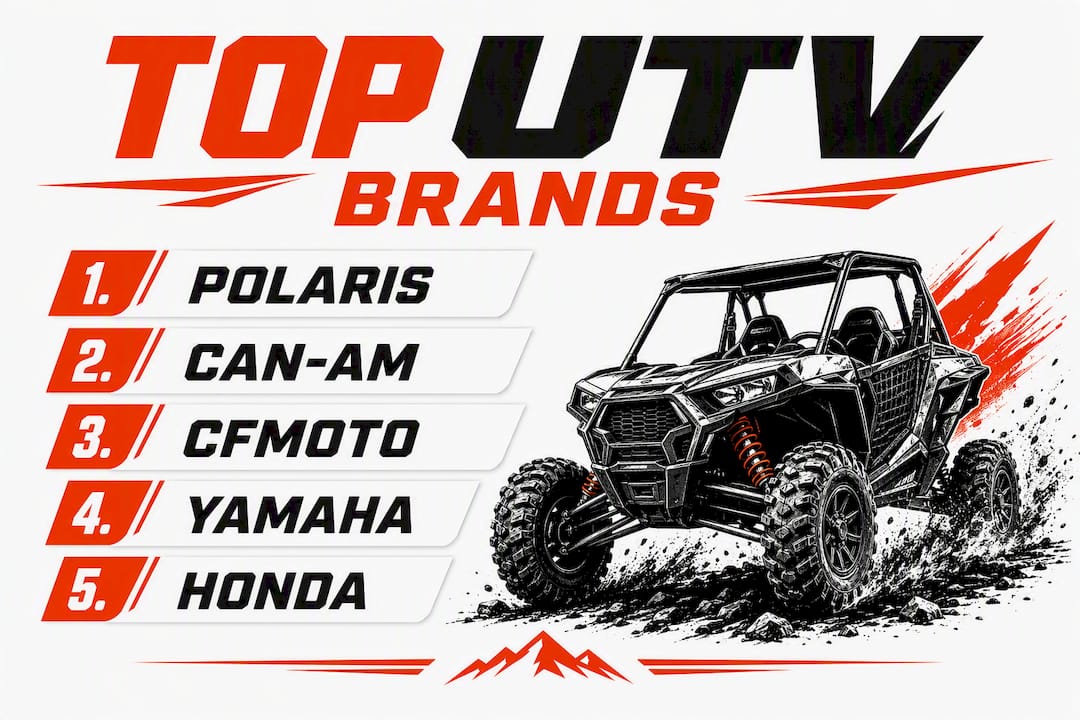
Industry reporting from SuperATV placed Polaris and Can-Am near the top of 2025 sales charts, with CFMOTO growing to appear among best-selling brands and sometimes outselling Honda in certain segments.
How we selected and evaluated these brands
The shortlist comes from applying a consistent set of criteria across every brand, not from brand recognition alone. Here is the framework:
- Use-case fit — Does the brand’s lineup actually serve the buyer’s primary need (sport, utility, mixed-use, or commercial)? A brand that excels at one use-case but fails at another gets credit only where it earns it.
- Reliability signals — Owner-community fault patterns, long-term durability reputation, and common maintenance issues. Reliability directly determines total ownership cost.
- Dealer and service network — How easy is it to get parts, warranty service, and routine maintenance? A machine with no nearby dealer is a liability, not an asset.
- Resale value — Brands with strong resale protect your investment. Legacy brands with proven track records tend to hold value better than newer entrants.
- Tech and safety features — Active safety technology (stability control, power steering, ABS-style systems) materially reduces incident risk, especially for less-experienced riders on varied terrain.
- Value per feature — What do you actually get for the price? This is where CFMOTO has shifted the conversation in 2026, offering features that legacy brands charge a premium for.
- Market momentum and ownership community — Sales trends, owner forums, and aftermarket ecosystem size all signal how well-supported a brand will be five years from now.
The Dirtybirdypowersports team rides and sells these machines. That hands-on perspective shapes every judgment here, particularly on CFMOTO where the dealership has direct delivery and service experience.
Pro Tip: Before committing to any brand, run the criteria above against your specific situation. A brand that scores well overall may still be the wrong pick if its nearest dealer is three hours away.
Brand-by-brand breakdown: strengths, weaknesses, and who each fits
Can-Am
Can-Am leads recreational performance. The Maverick R sits at the top of the sport segment, and the Defender line gives utility buyers a capable, well-supported option. Active safety integration including stability control and ABS on select models is a genuine differentiator for riders who push into demanding terrain. The trade-off: premium pricing and a warranty that is shorter than you might expect for the cost.
- Strengths: Sport performance, active safety tech, strong resale, wide BRP dealer network.
- Weaknesses: High entry price on performance models; shorter factory warranty relative to cost.
- Standout models: Maverick R (sport), Defender HD10 (utility).
- Price range: $15,000–$35,000+.
Polaris
Polaris runs the widest lineup of any manufacturer: Ranger for utility, RZR for sport, General for recreation-utility, and XPEDITION for enclosed adventure touring. That breadth is the point. If you want one brand to cover every use-case without switching manufacturers, Polaris is the default answer. Ride Command+ infotainment and HVAC on the XPEDITION show the brand pushing into comfort and tech territory. The electric Ranger XP Kinetic adds a zero-emission option for property work.
- Strengths: Portfolio breadth, largest US dealer network, strong resale, tech features.
- Weaknesses: Some models feel dated against newer competition; warranty is standard-length.
- Standout models: Ranger XP 1000 (utility), RZR Pro R (sport), XPEDITION (touring).
- Price range: $12,000–$40,000+.
Yamaha
Yamaha’s Wolverine RMAX family is the clearest example of a brand finding its lane and staying in it. The RMAX 1000 handles trail riding and light property work without asking you to choose between the two. Yamaha has phased out some pure-sport models, which narrows the lineup but sharpens the focus. Long-term reliability is among the best in the category, and resale reflects that.
- Weaknesses: — Narrower lineup than Polaris or Can-Am; fewer sport-focused options.
Kawasaki
Kawasaki built its UTV reputation on the Mule, a machine that has been hauling gear on farms and job sites for decades. The newer RIDGE and Teryx5 H2 show the brand expanding into more capable territory without abandoning its work-first DNA. If your primary use is property maintenance, livestock management, or construction-site transport, Kawasaki’s durability record is hard to argue with.
- Strengths: Proven heavy-duty durability, strong utility payload, established dealer network.
- Weaknesses: Less competitive in sport/recreation; tech features lag premium competitors.
- Standout models: Mule Pro-FXT (utility), RIDGE (work-focused innovation), Teryx5 H2 (sport-utility).
- Price range: $12,000–$25,000.
Honda
Honda’s approach to UTVs mirrors its motorcycle philosophy: engineer it right the first time, then refine slowly. The Pioneer 1000 uses a unique i-4WD system and offers genuine six-passenger capacity in some configurations. The Talon 1000R targets sport buyers with a high-revving engine and sport suspension. Neither is the cheapest option, but both tend to outlast the competition with lower unplanned maintenance costs.
- Strengths: Long-term durability, unique transmission options (DCT/iMT), strong resale.
- Weaknesses: Premium pricing; conservative styling; limited lineup breadth.
- Standout models: Pioneer 1000-6 (utility/family), Talon 1000R (sport).
- Price range: $15,000–$22,000.
CFMOTO
CFMOTO has moved well past its budget-brand origins. The UForce and ZForce families now compete directly with mid-tier models from legacy brands, offering EPS, digital displays, and capable suspension at prices that typically undercut the competition by several thousand dollars. Long-term resale and durability data are still accumulating, but the feature-per-dollar argument is compelling. Dirtybirdypowersports sells CFMOTO at MSRP with no markups, which removes the dealer-markup friction that inflates costs elsewhere.
- Strengths: Best value per feature, modern spec sheet, growing aftermarket support through Dirtybirdypowersports.
- Weaknesses: Resale value still maturing; long-term ownership record shorter than legacy brands.
- Standout models: UForce U10 PRO (utility), ZForce 950 Sport (recreation).
- Price range: $10,000–$18,000.
Kubota
Kubota belongs in a separate conversation from recreational UTVs. The RTV-X1140 runs a diesel engine, hydrostatic drive, and a payload capacity that commercial and agricultural buyers need. Speed is not the point. Control, torque, and durability under continuous load are. If you are managing a working farm or a large commercial property, Kubota’s two-year warranty and ag-dealer network make it a serious option.
- Strengths: Diesel power, best-in-class payload/towing, commercial-grade build, 2-year warranty.
- Weaknesses: Not recreational; slow top speed; higher price for the use-case.
- Standout model: RTV-X1140.
- Price range: $18,000–$28,000.
Hisun
Hisun competes on price. The Sector 750 and similar models come with a reasonable standard equipment list for the money, making them attractive to first-time buyers or those with limited budgets. The honest caveat: dealer coverage is thin in many US regions, and resale data is limited. Buy one knowing you may need to source parts online and handle more maintenance yourself.
- Strengths: Low entry price, reasonable standard equipment.
- Weaknesses: Thin dealer network, limited resale data, less refined ride quality.
- Standout model: Sector 750.
- Price range: $8,000–$13,000.
Segway Powersports
Segway Powersports entered the UTV market with spec sheets designed to turn heads. The Villain SX10 posts numbers that compete with established sport models. Newer entrants like Segway face real questions around parts availability, dealer network depth, and long-term resale, none of which can be answered yet with the same confidence as a brand with 20 years of owner data. Worth watching; not the safe choice for a buyer who needs reliable service support.
- Strengths: Aggressive specs, competitive pricing, modern electronics.
- Weaknesses: Limited ownership history, thin dealer network, resale unknown.
- Standout model: Villain SX10.
- Price range: $12,000–$20,000.
Speed UTV
Speed UTV builds machines around a concept: maximum off-road aggression in a purpose-built package. The El Diablo generated real enthusiasm from the enthusiast community. Production history is limited, and the dealer/service footprint is small. For a buyer who wants a weekend weapon and is comfortable sourcing support independently, it is worth a look. For anyone who needs a machine to work reliably every week, the risk profile is too high.
- Strengths: Concept-driven performance packaging, enthusiast appeal.
- Weaknesses: Very limited production history, small dealer network, resale data absent.
- Standout model: El Diablo.
- Price range: $25,000–$40,000+.
Which brand fits your specific need?
Recreation / sport: Can-Am leads here, with the Maverick R setting the benchmark for power and active safety. CFMOTO’s ZForce family offers a strong sport-recreation option at a lower price point.

Utility / work: Polaris Ranger and Kawasaki Mule are the two most proven choices. Kubota wins if diesel power and commercial payload are the priority. Utility-focused UTVs prioritize payload and towing over suspension agility, so match the machine to the actual workload.
Budget: CFMOTO through Dirtybirdypowersports gives you the most features per dollar among brands with real dealer support. Hisun is cheaper but comes with meaningful trade-offs in service coverage.
Electric: Polaris Ranger XP Kinetic is the most established electric UTV option from a major manufacturer with a wide service network.
Reliability / low maintenance: Yamaha and Honda consistently draw the strongest long-term reliability signals from owner communities. Both hold resale value well.
| Need | Top Pick | Runner-Up | Key Trade-off |
|---|---|---|---|
| Recreation / sport | Can-Am | CFMOTO ZForce | Performance vs. price |
| Utility / work | Polaris Ranger | Kawasaki Mule | Network breadth vs. work-focus |
| Budget | CFMOTO | Hisun | Dealer support vs. lowest price |
| Electric | Polaris Ranger XP Kinetic | — | Range and charging infrastructure |
| Reliability | Yamaha | Honda | Lineup breadth vs. longevity |
Mixed-use buyers face the hardest trade-off: sport performance and cargo capability rarely peak in the same machine. The Yamaha Wolverine RMAX and Polaris General are the two models that come closest to splitting the difference without a major compromise on either side.
How to choose the right UTV brand for your situation
Answer these five questions before you shortlist a single model:
- What is your primary use? Recreational trail riding, property/farm work, and commercial hauling each point to different brands. Be honest about which use-case will account for 80% of your hours.
- How many passengers do you need to carry? Two-seat and four-seat configurations have different weight distributions, suspension tuning, and price points.
- What terrain will you cover? Rocky trails demand long-travel suspension. Flat farm ground rewards payload over ground clearance.
- What is your realistic maintenance budget? Premium brands cost more to service. Budget brands may cost more in unplanned repairs.
- Where is your nearest dealer? A machine with no nearby service center is a problem waiting to happen.
Buyer flow:
- Shortlist two or three brands based on your primary use-case.
- Match each brand’s standout model to your specific payload, passenger, and terrain requirements.
- Inspect key specs: engine displacement, suspension travel, payload rating, towing capacity, and bed dimensions.
- Test-ride at least two models before committing.
- Confirm warranty terms, service intervals, and parts lead times with the dealer before signing.
Red flags during inspection or test rides:
- Excessive steering play or vague on-center feel.
- Unusual drivetrain noise under load.
- Dealer cannot confirm parts availability or typical service wait times.
- No clear answer on what the warranty covers and what it excludes.
What ownership actually costs beyond the sticker price
The MSRP gap between brands narrows quickly once you factor in maintenance, parts, and depreciation. Ownership costs vary most with reliability, dealer labor rates, and parts availability.
Recurring costs to budget for:
- Scheduled oil and filter changes (typically every 50–100 hours of use).
- Air filter replacement, especially in dusty or muddy conditions.
- Tire wear: aggressive terrain chews through tires faster than most buyers expect. Upgrading to quality aftermarket radials like Braven Hellhound Uber XOR tires extends service life on demanding terrain.
- Belt replacement on CVT-equipped models (a common wear item across most brands).
- Brake fluid, coolant, and differential fluid at manufacturer-specified intervals.
- Winterization if the machine sits for extended cold-weather periods.
Warranty comparison: Kubota’s two-year limited warranty stands out in the utility segment. Most major brands offer one-year limited coverage. Shorter warranties on premium-priced machines (Can-Am, some Honda models) are worth factoring into the total cost calculation.
Resale trends: Legacy brands with wide dealer networks hold value better. Yamaha and Honda consistently show strong resale. Polaris and Can-Am follow closely. CFMOTO’s resale is improving as the brand gains market share. Hisun, Segway, and Speed UTV have limited resale data, which means higher depreciation risk.
Market signals from best-seller data confirm that consumer demand favors brands balancing dealer support with competitive pricing, and the resale premium persists for legacy brands with proven durability and wide service networks.
What emerging brands and safety tech mean for buyers right now
The value equation in the UTV market shifted meaningfully in 2025 and 2026. Emerging brands are forcing legacy manufacturers to justify their price premiums, and active safety technology is becoming a real differentiator rather than a marketing checkbox.
CFMOTO’s growth into the best-seller conversation is the clearest signal of this shift. Feature-rich machines at lower price points are no longer a compromise; they are a legitimate alternative for buyers who do not need the last 10% of performance that premium brands charge heavily for.
Active safety features matter more than most buyers realize before they own a machine. Stability control, refined power steering, and ABS-style braking systems reduce rollover and loss-of-control incidents, particularly for less-experienced riders on unpredictable terrain. Can-Am leads this category among major brands, but the gap is closing.
Pro Tip: When comparing models, check whether EPS (electronic power steering) is standard or an add-on. On rough terrain, EPS is not a luxury feature. It reduces fatigue on long rides and gives you better control in technical sections.
For buyers thinking about future-proofing, three features are worth prioritizing: enclosed cab with HVAC (Polaris XPEDITION leads here), infotainment integration, and electric drivetrain availability. These are niche today but will define the premium segment within five years.
Key Takeaways
CFMOTO through Dirtybirdypowersports offers compelling value per feature, while Polaris, Can-Am, Yamaha, and Honda lead in specific use-cases with strong legacy track records and dealer networks.
| Point | Details |
|---|---|
| Best overall value | CFMOTO delivers modern specs at prices that undercut comparable legacy models, with dealer support through Dirtybirdypowersports. |
| Best for range | Polaris covers utility, sport, recreation, and electric in one lineup, making it the default for multi-use buyers. |
| Reliability leaders | Yamaha and Honda consistently show the strongest long-term reliability and resale signals from owner communities. |
| Ownership costs | Budget for belts, tires, fluids, and scheduled service; warranty length and dealer proximity drive total cost more than MSRP alone. |
| Dirtybirdypowersports | Sells CFMOTO at MSRP with no markups, nationwide delivery, and a 5.0 Google rating backed by over 200 successful deliveries. |
The real lesson most UTV buyers miss
The brand debate usually focuses on horsepower and price. Those matter, but the buyers who end up happiest are the ones who weighted dealer proximity and parts availability as heavily as the spec sheet.
A machine from a brand with a thin dealer network is a different ownership experience than the same machine from a brand with a service center 20 minutes away. That gap shows up the first time you need a warranty repair or a specific part on a tight timeline. Legacy brands built their reputations partly on this infrastructure, and it is a real advantage that does not show up in a comparison table.
The other thing most buyers underestimate: the value brands have genuinely closed the feature gap. CFMOTO in 2026 is not the CFMOTO of five years ago. The machines are better, the parts ecosystem is growing, and dealers like Dirtybirdypowersports are building the service infrastructure that makes long-term ownership practical. The resale question is still open, but for a buyer who plans to ride the machine rather than flip it, the value case is strong.
Buy the brand whose dealer you trust, not just the machine whose spec sheet impressed you.
CFMOTO at MSRP: what Dirtybirdypowersports offers buyers right now
If value and modern features are your priority, CFMOTO through Dirtybirdypowersports is the clearest path to a well-equipped machine without the dealer-markup tax that inflates costs at most powersports stores.
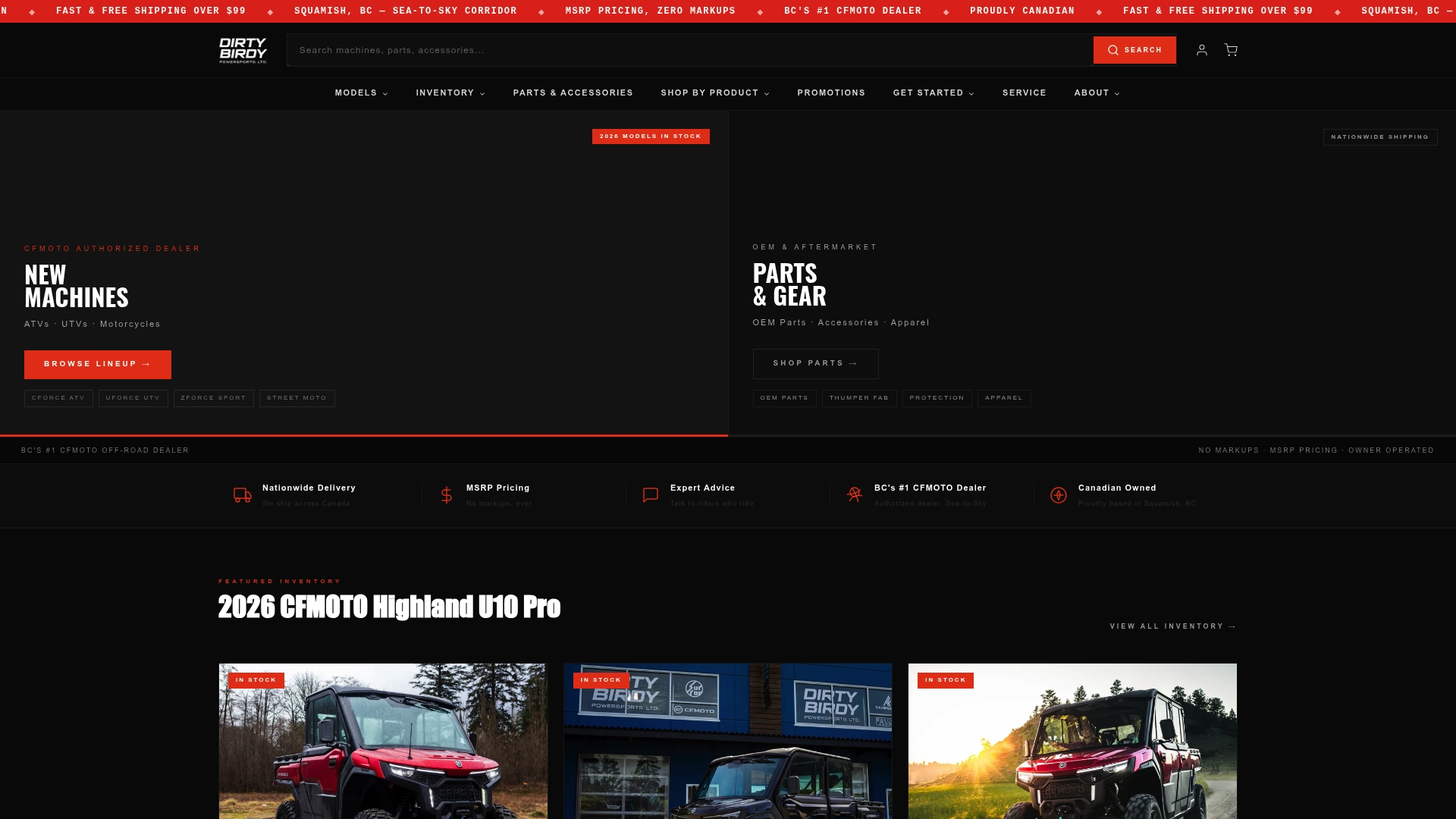
Dirtybirdypowersports sells every CFMOTO at MSRP with zero markups, ships nationwide across Canada, and backs every sale with a team that actually rides the machines they sell. The dealership carries a 5.0 Google rating across more than 200 completed deliveries. For buyers who want to upgrade their machine from day one, the parts and accessories catalog covers premium UTV tires, mirrors, bumpers, and protection gear, all stocked and ready to ship.
Browse inventory, request a quote, or schedule a conversation with the team at dirtybirdypowersports.com.
Useful sources
- UTV Brands in 2026 — UTV Guide: Market commentary on CFMOTO’s growth, Polaris portfolio breadth, Yamaha’s RMAX focus, and Kubota’s commercial positioning.
- Best-Selling UTV and ATV Brands (2025) — SuperATV: 2025 sales data placing Polaris and Can-Am at the top, with CFMOTO appearing among best-sellers.
- What Are the Best UTV Brands — MotorTrend: Covers Polaris tech additions, electric Ranger XP Kinetic, and ownership questions for newer entrants like Segway and Speed UTV.
For model-level spec sheets, warranty documents, and owner forum discussions, use the manufacturer pages above as your starting point, then cross-reference with owner communities on platforms like UTV Driver and Reddit’s r/SxS before finalizing your shortlist. Contact a local dealer for current pricing and test-ride availability.