

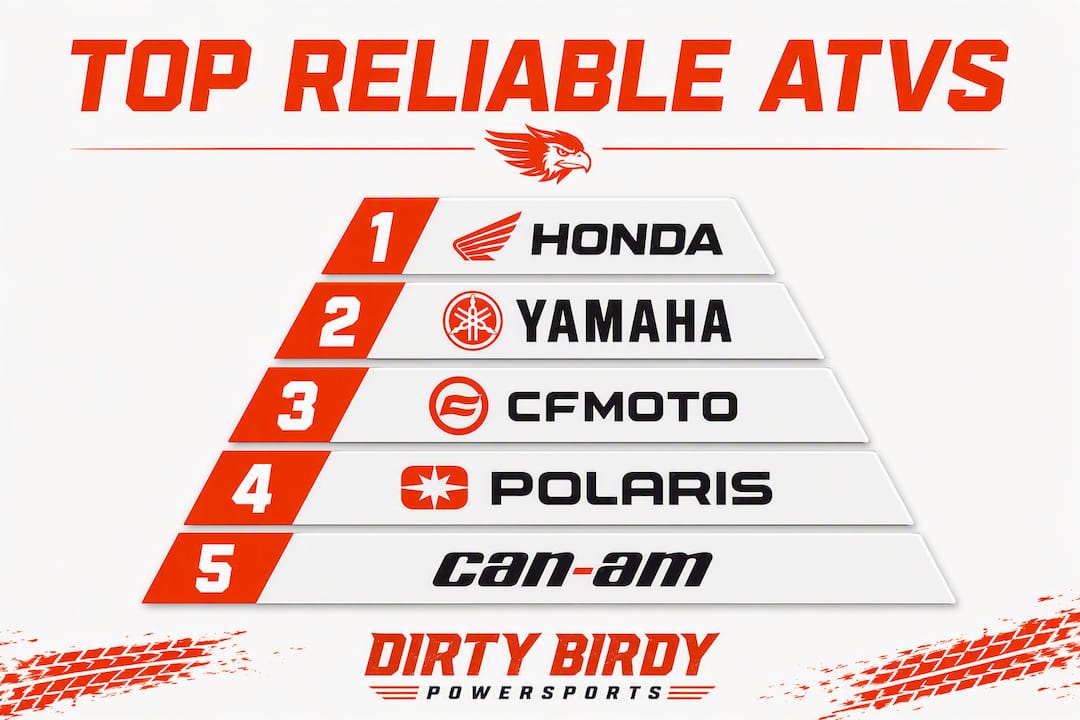
Honda, Yamaha, Polaris, Can-Am (BRP), Kawasaki, Suzuki, Arctic Cat (Textron Off Road), and CFMOTO make up the short list of best ATV brands worth considering in 2026. For most buyers, Honda or Yamaha is the safest long-term bet because of their proven drivetrains, dense dealer networks, and strong resale values. If budget is the priority and you have local dealer access, CFMOTO delivers more features per dollar than any legacy brand at the same price point.
- Long-term reliability pick: Honda or Yamaha. Decades of owner data, parts on shelves nationwide, and resale values that hold.
- Value pick: CFMOTO. Factory-included winches, EPS, and LED lighting at MSRPs that undercut comparable Honda and Yamaha trims. Best when a CFMOTO dealer is within a reasonable drive.
- Performance pick: Can-Am (BRP) or Polaris. If you want the most capable machine on the market and are willing to pay for it, these two lead the pack.
Table of Contents
- How do the top ATV brands compare at a glance?
- What should you expect from each brand?
- Which ATV models have the strongest reliability records?
- How do you choose the right ATV brand for your needs?
- Which ATV brands should you avoid, and why?
- How we selected these brands and models
- Key Takeaways
- A straight take on what actually matters when buying an ATV
- Dirtybirdypowersports carries CFMOTO and the accessories to go with it
- Useful sources and further reading
How do the top ATV brands compare at a glance?
| Brand | Best for / Use case | Typical price / Value | Reliability & drivetrain | Dealer network & parts | Resale value | Warranty & support | Standout models |
|---|---|---|---|---|---|---|---|
| Dirtybirdypowersports | CFMOTO buyers wanting dealer support + accessories | MSRP, no markup | CFMOTO drivetrain, growing track record | Nationwide delivery (Canada); OEM + aftermarket parts | Competitive for segment | CFMOTO factory warranty | CFORCE 600 Touring |
| Honda | Utility, acreage, long-term ownership | Mid-range; strong value retention | Best-in-class; proven over decades | Extensive U.S. dealer network | Highest in class | 6-month limited + extended options | FourTrax Rancher, Foreman Rubicon |
| Yamaha | Trail + utility, comfort-focused riders | Mid-to-upper; holds value well | Excellent; Ultramatic transmission | Strong U.S. footprint | Very strong | 6-month + 10-year belt warranty (select trims) | Grizzly 700, Kodiak 700 |
| Polaris | Versatile work/trail; performance buyers | Mid-to-premium | Good; some model-specific quirks | Very wide U.S. dealer network | Good | 6-month limited | Sportsman 570, Sportsman XP 1000 |
| Can-Am (BRP) | Performance, high-demand utility | Premium | Strong; Rotax engines well-regarded | Good U.S. coverage | Good | 6-month limited | Outlander 700 MAX XT, Outlander 850 |
| Kawasaki | Straightforward power, durability | Mid-range | Solid; V-twin engines proven | Moderate U.S. network | Moderate | 1-year limited | Brute Force 750 |
| Suzuki | Used-market buyers, simple utility | Budget-to-mid | Reliable; limited new model updates | Shrinking dealer base | Moderate | 24-month limited | KingQuad 750 |
| Arctic Cat (Textron) | Value utility, used-market | Budget-to-mid | Decent; Textron ownership improving | Moderate; improving | Below average | 6-month limited | Alterra 600 TRV |
| CFMOTO | Feature-value buyers, beginners | Budget-to-mid; best feature-per-dollar | Growing; shorter long-term record | Expanding U.S. network | Improving | 1-year limited | CFORCE 600 Touring |
What should you expect from each brand?
Honda
Honda’s reputation in the ATV world is built on one thing: drivetrains that simply refuse to quit. The FourTrax Rancher and Foreman Rubicon have been workhorses on farms and trails for years, and owner forums are full of machines with well over 10,000 miles on original engines. The Foreman Rubicon’s five-speed manual transmission is genuinely unique in the market and, as ATV.com puts it, “as unkillable as they come.” Dealer coverage across the U.S. is among the deepest of any brand, which means parts are rarely a wait-and-see situation.
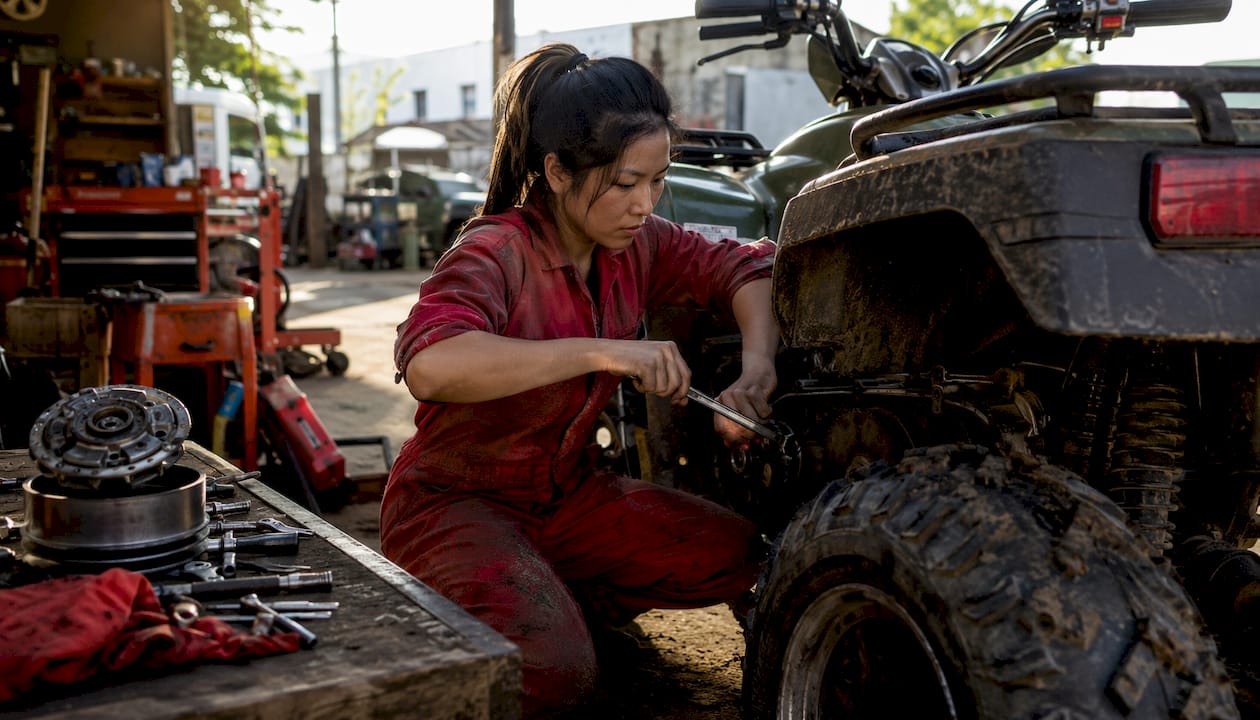
Resale is another Honda strength. A well-maintained Rancher or Foreman holds value better than almost anything else in the utility segment. If you plan to own for five-plus years or eventually sell, Honda is the smart financial choice.
Standout models: Honda FourTrax Rancher (utility/acreage), Honda FourTrax Foreman Rubicon 4x4 (heavy-duty utility), Honda FourTrax Rincon (touring/comfort), Honda FourTrax 350 4x4 (budget/light-duty).
Yamaha
Yamaha’s Ultramatic CVT transmission is the best automatic in the segment, and the brand backs it with a 10-year belt warranty on select Grizzly trims. That warranty alone tells you something about how confident Yamaha is in the drivetrain. The Grizzly 700 is light on its feet, handles well on mixed terrain, and the 2025 update brought a new EPS system and LED lighting front and rear. The Kodiak leans more toward utility work and is a dependable daily driver for property tasks.
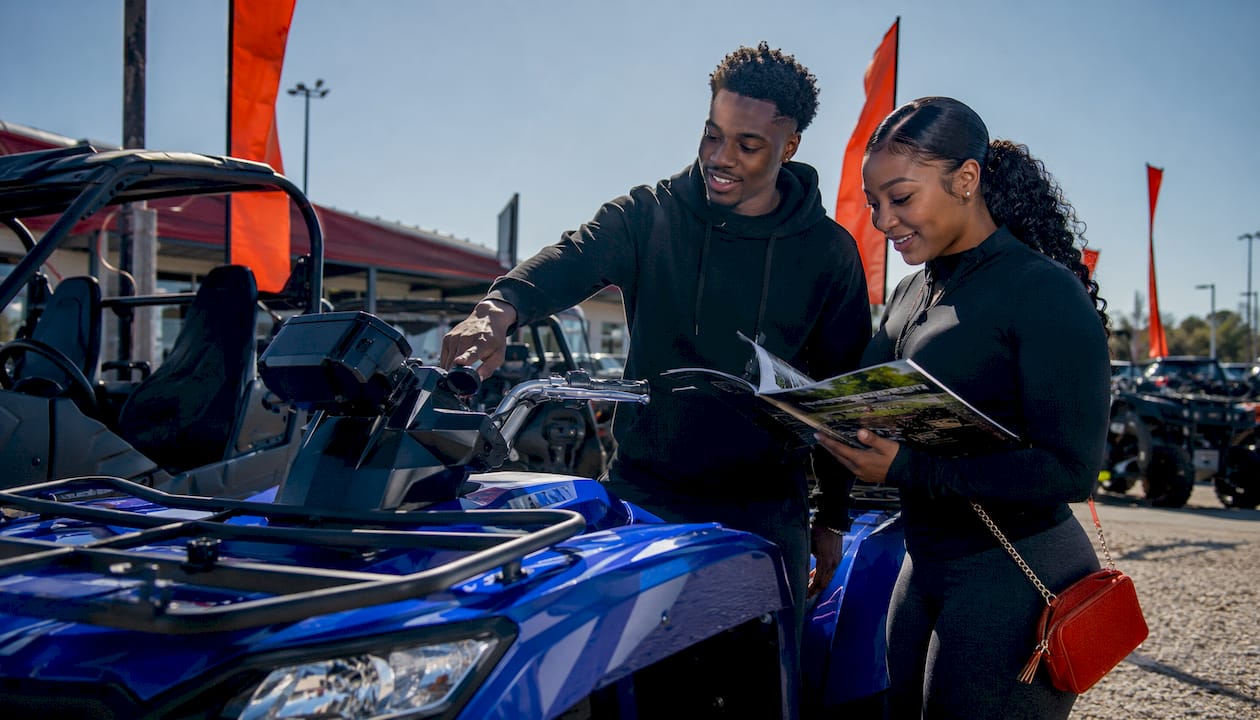
Yamaha’s dealer network is strong throughout the U.S., and parts availability is rarely an issue. Resale tracks closely with Honda, making either brand a safe long-term investment.
Standout models: Yamaha Grizzly 700 (trail/comfort), Yamaha Kodiak 700 (utility/property work).
Polaris
Polaris leads in sheer lineup breadth. From the practical Sportsman 570 to the over-the-top Sportsman XP 1000 Ultimate with its 90-horsepower engine, 12 inches of ground clearance, and 7-inch RIDE COMMAND display, there is a Polaris for nearly every use case. The Sportsman 570 is the entry point most buyers should consider: 44 horsepower, 1,350-pound towing capacity, and widely available in EPS trim. Step up to the XP 1000 and you get a machine that, as ATV.com notes, is “unquestionably a ton of quad.”
Reliability is generally solid, though some model years have had specific quirks that show up in owner forums. The dealer network is one of the widest in the U.S., so service access is rarely a problem.
Standout models: Polaris Sportsman 570 Touring Premium (versatile work/trail), Polaris Sportsman XP 1000 (high-end performance).
Can-Am (BRP)
Can-Am builds some of the most capable ATVs on the market. The Rotax engine lineup is well-regarded for power density, and Dynamic Power Steering (DPS) is standard on most trims. The Outlander 700 MAX XT is the two-up touring standout, while the Outlander 850 and 1000R are the go-to choices for riders who want genuine performance without sacrificing utility. The 1000R produces 101 horsepower from a 999cc Rotax V-twin, and the XT package adds a 3,500-pound winch, heavy-duty bumpers, and 26-inch tires from the factory.
Can-Am pricing sits at the premium end, but the feature-per-dollar ratio at the XT trim level is genuinely competitive. Dealer coverage in the U.S. is good, though not quite as dense as Honda or Polaris.
Standout model: Can-Am Outlander 700 MAX XT (two-up touring/performance utility).
Kawasaki
The Brute Force 750 has been around long enough that every independent mechanic in the country knows how to work on it. The 749cc V-twin is not the most powerful engine in the segment, but it is proven, and the 732-pound wet weight keeps the machine nimble. Kawasaki has not made major mechanical changes to the Brute Force in years, which is actually a feature for buyers who prioritize known reliability over the latest tech. Parts are easy to source, and the used market is healthy.
Standout model: Kawasaki Brute Force 750 (straightforward utility/durability).
Suzuki
Suzuki’s KingQuad 750 is a dependable, no-fuss machine with a 722cc single-cylinder engine, 1,322-pound towing capacity, and a comfortable seating position. The 24-month limited warranty is one of the longer factory coverages in the segment. The honest caveat: Suzuki has not invested heavily in updating the KingQuad lineup, and the dealer base has shrunk over the years. For a new purchase, parts availability and service access deserve extra scrutiny depending on your location. The KingQuad makes more sense as a used-market buy where the price reflects the brand’s reduced market presence.
Arctic Cat (Textron Off Road)
Arctic Cat, now under Textron ownership, has been rebuilding its reputation since the acquisition. The Alterra 600 TRV offers a competitive feature set for the price and is a reasonable option for buyers who want a capable utility machine without paying legacy-brand premiums. The dealer network is moderate and improving, but parts lead times can be longer than Honda or Yamaha in some regions. Best approached as a value option or a used-market buy.
Standout model: Arctic Cat Alterra 600 TRV (value utility/trail).
CFMOTO
CFMOTO is the most interesting story in the ATV market right now. Sales growth has been rapid, and the CFORCE 600 Touring punches well above its price class. For just over $7,000, you get a 580cc engine making 44 horsepower, a 3,500-pound winch, EPS, LED lighting, and hand guards from the factory. That package would cost several thousand more from Honda or Yamaha. The trade-off is a shorter long-term ownership record compared to legacy brands, and the quality of your experience depends heavily on having a good local dealer.
Standout model: CFMOTO CFORCE 600 Touring (value/feature-rich utility).
Pro Tip: Before you commit to any brand, call the nearest dealer and ask one specific question: “How long does a typical parts order take for this model?” A dealer who answers confidently with a short lead time is a dealer who actually stocks inventory. One who hedges or says “it depends” is a warning sign worth taking seriously.
Which ATV models have the strongest reliability records?
Industry roundups and owner-report data consistently surface the same models as the most dependable options across brands. Here is the short list, with a note on who each one suits best.
- Honda FourTrax Rancher — Utility/acreage. The benchmark for long-term reliability in the utility segment. Ideal for farm and property work where downtime is not an option.
- Honda FourTrax Foreman Rubicon 4x4 — Heavy-duty utility. The unique five-speed manual transmission and stout drivetrain make it the choice for buyers who push their machines hard.
- Honda FourTrax 350 4x4 — Light-duty/budget. Simple, low-maintenance, and genuinely hard to break. Good for buyers who want a reliable machine without a large upfront investment.
- Yamaha Grizzly 700 — Trail/mixed use. The Ultramatic transmission and 10-year belt warranty make this the comfort and reliability pick for riders who cover varied terrain.
- Yamaha Kodiak 700 — Utility/property. Dependable 4x4 system and practical ergonomics for full-day work sessions.
- Polaris Sportsman 570 Touring Premium — Versatile work/trail. Broadly capable, widely available, and a solid first ATV for buyers who want factory comfort features without going premium.
- Polaris Sportsman XP 1000 — High-end performance. For experienced riders who want the most capable machine in the Polaris lineup. Not a beginner’s ATV.
- Can-Am Outlander 700 MAX XT — Two-up touring/performance utility. DPS, Rotax power, and a two-up chassis make it the best choice for riders who want to bring a passenger.
- CFMOTO CFORCE 600 Touring — Value/feature-rich utility. The best feature-per-dollar machine on this list. Buy it when you have a solid local CFMOTO dealer.
- Arctic Cat Alterra 600 TRV — Value utility. A capable option for buyers who want a two-up or trail-capable machine at a lower price point, with the caveat that parts access varies by region.
When picking between these models, prioritize local dealer stock and confirmed parts availability over spec-sheet comparisons. A machine with slightly lower horsepower that your dealer can service in two days beats a better-spec’d machine that sits waiting for parts for three weeks.
How do you choose the right ATV brand for your needs?
The short answer: match the brand’s strengths to your primary use case, then verify dealer support before you sign anything.
Buyer criteria checklist:
- Primary use (utility/farm work, trail riding, hunting, two-up touring, or a mix)
- Engine displacement needs (mid-bore 500–700cc covers most use cases; 850cc+ for demanding work or performance)
- Towing and hauling capacity requirements
- Ergonomics and suspension comfort, especially for full-day rides
- Dealer proximity and demonstrated parts availability
- Warranty terms and what they actually cover
- Expected ownership period and resale plans
Questions to ask at the dealership:
- What is your average service turnaround time for this model?
- Do you stock common wear parts (belts, filters, brake pads) on the shelf?
- Can you show me a recent warranty claim you handled?
- What accessories do local riders add to this machine most often?
- Is a test ride available before purchase?
A test ride and dealer consultation are not optional extras. Ergonomics and transmission feel determine long-term satisfaction more than any spec sheet figure.
Red flags to watch for:
- Parts lead times measured in weeks, not days
- Fewer than two dealers within a reasonable drive
- Warranty terms that exclude drivetrain components
- Pricing that seems too low from an unfamiliar importer
- No test ride offered or available
First-year cost note: Budget for more than the sticker price. Accessories (tires, grips, mirrors, a winch if not factory-included), registration, insurance, and the first service interval add up. Basic upgrades and maintenance can significantly increase the first-year cost beyond the sticker price for a mid-range ATV.
Which ATV brands should you avoid, and why?
“Brands to avoid” does not mean bad machines. It means brands where the ownership experience breaks down after the sale because of parts scarcity, weak warranty support, or a thin dealer network.
The objective criteria for “avoid”:
- No dealer within a reasonable drive
- Parts catalog that is incomplete, slow to ship, or dependent on a single importer
- Warranty language that is vague or excludes major components
- No established owner community or forum where you can source help
- Grey-market or parallel-import status that voids factory warranty
Decision flow for evaluating an unfamiliar brand:
- Search the brand name plus “parts availability” and “owner forum” before visiting a dealer.
- Count the number of authorized dealers within 100 miles. Fewer than two is a risk.
- Ask the dealer to show you the parts catalog and confirm lead times for common wear items.
- Read warranty terms carefully. A 30-day or 90-day warranty on a new machine is a red flag.
- Check whether local independent mechanics are familiar with the brand.
Grey-market imports and obscure brands with inconsistent model naming are the highest-risk category. Long parts lead times turn minor repairs into weeks of downtime, and that cost is invisible on the sticker price. If you are buying used from a lesser-known brand, only proceed if you have a confirmed parts source and the mechanical skill to handle repairs yourself.
How we selected these brands and models
The brands and models in this article were selected using a combination of industry editorial reviews, owner-report data, dealer footprint analysis, and resale value records.
Selection criteria:
- Reliability records drawn from owner forums, editorial roundups, and long-term test reports
- Dealer and parts footprint across the U.S.
- Resale value data from auction and private-sale markets
- Product variety and lineup depth
- Warranty terms and demonstrated post-sale support
- Editorial and owner-report consensus across multiple independent sources
Primary sources used:
- Ritchie Bros. Blog (industry resale and reliability data)
- ATV.com (model-level editorial reviews and utility ATV roundups)
- Riva Motorsports Space Coast (dealer perspective and test-ride guidance)
- SuperATV (sales ranking and market share data)
- Manufacturer pages (Polaris, Can-Am, Honda, Yamaha) for warranty terms and specifications
Disclosure: This article is published by Dirtybirdypowersports, an authorized CFMOTO dealer. CFMOTO is recommended where it objectively fits the buyer’s needs. All other brands are evaluated on their merits, and no brand has paid for placement in this article.
Dealer support is the single factor that most strongly predicts long-term ownership satisfaction. A machine with a slightly lower spec sheet from a brand with a strong local dealer will almost always deliver a better ownership experience than a higher-spec machine from a brand with thin service coverage.
Key Takeaways
Honda and Yamaha remain the most reliable long-term picks for most buyers, while CFMOTO delivers the strongest feature-per-dollar value for buyers who have local dealer access.
| Point | Details |
|---|---|
| Dealer support matters most | Parts availability and service turnaround time predict ownership satisfaction more than peak horsepower. |
| Honda and Yamaha lead on reliability | Decades of owner data, dense U.S. dealer networks, and strong resale values make both the safest long-term picks. |
| CFMOTO is the value leader | Factory-included winches, EPS, and LED lighting at lower MSRPs than comparable legacy trims, best when a dealer is nearby. |
| Test ride before you buy | Ergonomics and transmission feel determine long-term satisfaction; always request a test ride and ask about parts lead times. |
| Dirtybirdypowersports for CFMOTO buyers | Transparent MSRP pricing, OEM and aftermarket parts, and nationwide delivery make Dirtybirdypowersports a strong option for CFMOTO shoppers. |
A straight take on what actually matters when buying an ATV
The ATV market is full of spec-sheet wars, and most of them are distractions. Buyers obsess over horsepower numbers when the real question is: can your dealer get a belt or a brake caliper in two days? A 90-horsepower machine sitting in a shop for three weeks waiting on parts is worth less than a 44-horsepower machine that never misses a day of work.
Honda and Yamaha have earned their reputations the hard way, over decades of owner data. That is not marketing. It is the accumulated result of conservative engineering choices, dense dealer networks, and parts that are genuinely stocked on shelves. If you are buying your first ATV or planning to own for a long time, that track record is worth paying for.
CFMOTO is a different conversation. The CFORCE 600 Touring is a genuinely impressive machine for the money, and the brand’s growth is real. But “value” only holds if the dealer experience holds. A CFMOTO with a strong local dealer is a smart buy. A CFMOTO bought online from a distant dealer because the price was right is a gamble on parts access.
The brands-to-avoid conversation is also more nuanced than most articles admit. It is not about the machines being bad. It is about the ownership ecosystem. A grey-market import with no local dealer, no parts catalog, and a 90-day warranty is a liability regardless of how good it looks on paper.
Buy the brand whose dealer you trust. Everything else is secondary.
Dirtybirdypowersports carries CFMOTO and the accessories to go with it
If CFMOTO landed on your shortlist after reading this, Dirtybirdypowersports is the dealer that removes the guesswork. MSRP pricing with no markups means the price you see is the price you pay, and the team rides the machines they sell. That matters when you are asking whether a CFORCE 600 Touring is the right fit for your property or your trails.
Beyond the machines themselves, Dirtybirdypowersports stocks OEM and aftermarket parts and accessories for CFMOTO riders, including premium ATV radials and aggressive-terrain tires that change what your machine can do on the trail or the farm. Nationwide delivery across Canada means geography is not a barrier. Browse the inventory or reach out for a quote at dirtybirdypowersports.com.
Useful sources and further reading
| Source | What it covers | Why it matters |
|---|---|---|
| Ritchie Bros. Blog — Best and Most Reliable ATV Brands | Brand reliability rankings, dealer footprint analysis, resale value data | Industry auction perspective on long-term ownership and resale |
| ATV.com — Best Utility ATVs 2025 | Model-level editorial reviews, transmission and ergonomics notes, utility rankings | Hands-on editorial assessments of current model-year machines |
| Riva Motorsports Space Coast — Best ATV Brands | Dealer perspective on brand selection, test-ride guidance, owner satisfaction | Practitioner insight on what buyers get wrong during the purchase process |
| SuperATV — Best Selling UTV and ATV Brands 2025 | Sales rankings and market share data for major brands | Confirms which brands are actually moving units and growing market presence |
| Polaris Off-Road — ATVs and 4-Wheelers | Factory specs, warranty terms, and model lineup details | Primary source for Polaris warranty language and feature descriptions |
| Can-Am Off-Road — ATVs | Rotax engine specs, DPS details, model lineup and configurations | Primary source for Can-Am drivetrain specs and factory equipment packages |