

Most ATVs are best served by a winch sized to about one and a half to two times their working weight, with a moderate capacity choice often favored for many mid-size machines. The quick math: size your winch to 1.5–2× your ATV’s working weight, not just its curb weight. Riding in mud, hauling a plow, or running bigger tires? Step up a size.
TL;DR:
- Choose a winch with a capacity of 1.5 to 2 times your ATV’s fully loaded weight, accounting for mud, steep angles, and debris that increase load.
- Most riders prefer 3,000 pounds for mid-size ATVs, with heavier-duty models up to 3,500 pounds for frequent heavy hauling or plowing tasks.
- Factor in additional weight from accessories, racks, tires, and rated conditions like mud or inclines when sizing your winch to prevent overload.
- Synthetic rope offers weight and safety advantages over steel cable but requires regular inspection and protective sleeves for abrasive terrain.
- Proper electrical setup, waterproof mounting, and safety precautions like dampers are crucial for effective, safe winch operation.
Table of Contents
- How Winch Ratings Work (and Why You Should Size Above Curb Weight)
- Recommended Winch Capacities by ATV Size and Use Case
- How Terrain and Accessories Change Your Winch Size
- Synthetic Rope vs. Steel Cable: Which Should You Choose?
- Battery, Wiring, and Mounting: What Actually Limits Your Pull
- Safety Steps Every Winch User Should Follow
- Where Dirty Birdy Powersports Fits Into Your Winch Decision
- Editorial Take: Why Most Sizing Advice Oversimplifies the Decision
- Sources
How Winch Ratings Work (and Why You Should Size Above Curb Weight)
A winch’s advertised capacity is its rated line pull, the maximum force it can generate on the first, bottom layer of the drum, in a straight line, under ideal conditions. That number looks impressive on a spec sheet, but real recoveries often require more pulling power than ideal conditions suggest.
Every layer of rope wound onto the drum reduces pulling power, since each wrap increases the drum’s effective diameter. Add an uphill angle, mud suction, or a machine buried past its axles, and the load your winch actually feels can run well above your ATV’s parked weight. That’s the entire logic behind the 1.5–2× rule.
Here’s a simple example: your ATV weighs 700 lb dry. Add a rider, gear, and a rack, and your working weight climbs to roughly 900 lb. Multiply that by 1.5 to 2, and you land in the 1,350–1,800 lb range as your minimum effective pulling requirement, before even accounting for mud or incline. That’s why manufacturer guidance points to sizing at roughly 1.5 times fully loaded weight rather than curb weight alone.
Factors that inflate effective load beyond simple math:
- Steep or awkward recovery angles that reduce mechanical efficiency
- Mud or wet clay creating suction that resists initial movement
- Drag from rocks, roots, or debris along the pull path
- Rope layering on the drum during longer pulls
Recommended Winch Capacities by ATV Size and Use Case
Engine displacement is a reasonable shorthand for ATV weight, and weight is what actually drives your winch decision. Sizing guidance built around the 1.5–2× working-weight rule maps cleanly onto the capacity bands most riders actually buy.
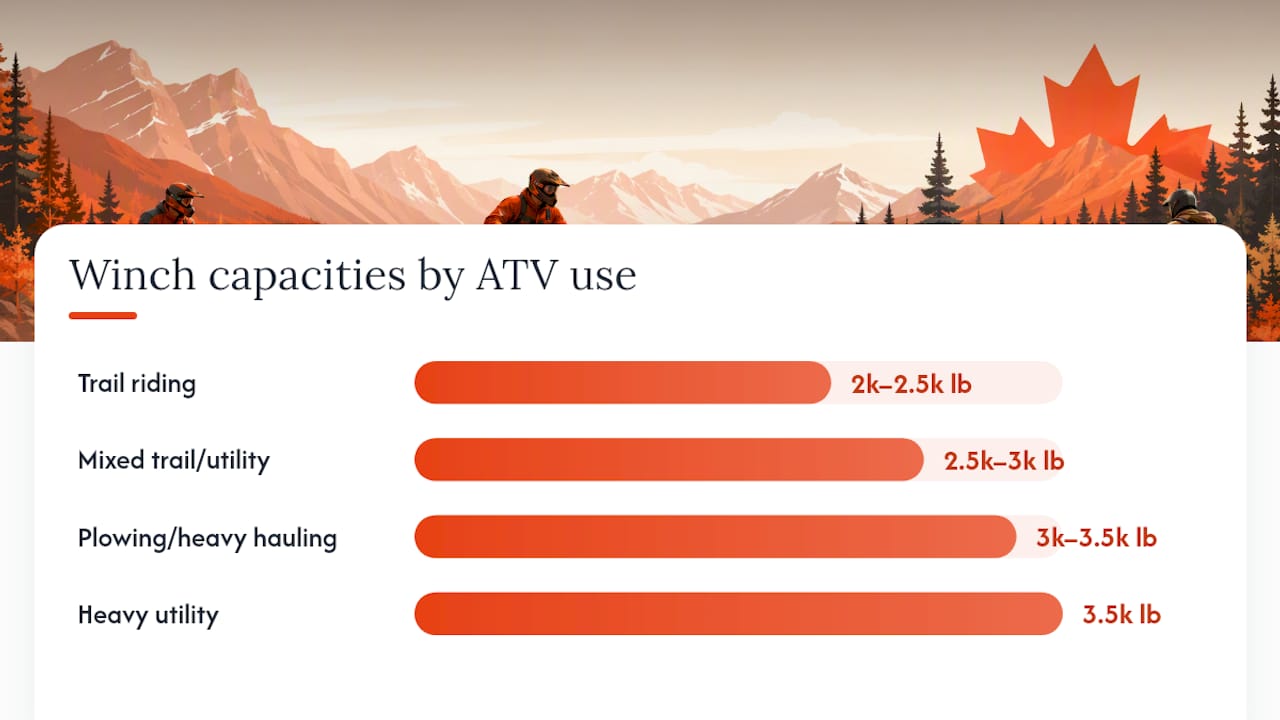
For smaller utility ATVs, a lower winch capacity is advisable, scaling up to higher capacities for larger and heavier ATVs as working weights increase, within a typical range generally advised by ATV manufacturers.
Most mid-size riders gravitate toward 3,000 lb for good reason. It covers the working-weight math for the average ATV plus gear, without the added bulk, cost, or electrical draw of a winch built for a UTV. Warn Industries’ own guidance puts ATV capacities in the 2,500–3,500 lb range and reserves anything starting at 3,500 lb for UTVs, which tend to run heavier and carry more accessories.
Match the capacity to how you actually ride:
- Trail riding, light recovery: 2,000–2,500 lb covers occasional stuck situations on established trails.
- Mixed trail and utility work: 2,500–3,000 lb handles varied terrain and moderate accessory loads.
- Plowing or frequent heavy hauling: 3,000–3,500 lb gives margin for repeated, high-load pulls.
- Heavy utility with racks and gear: 3,500 lb keeps you well above your true working weight.
How Terrain and Accessories Change Your Winch Size
Your ATV’s dry weight on a spec sheet is just the starting number. Riding conditions and add-ons push your real working weight higher, sometimes by a lot.
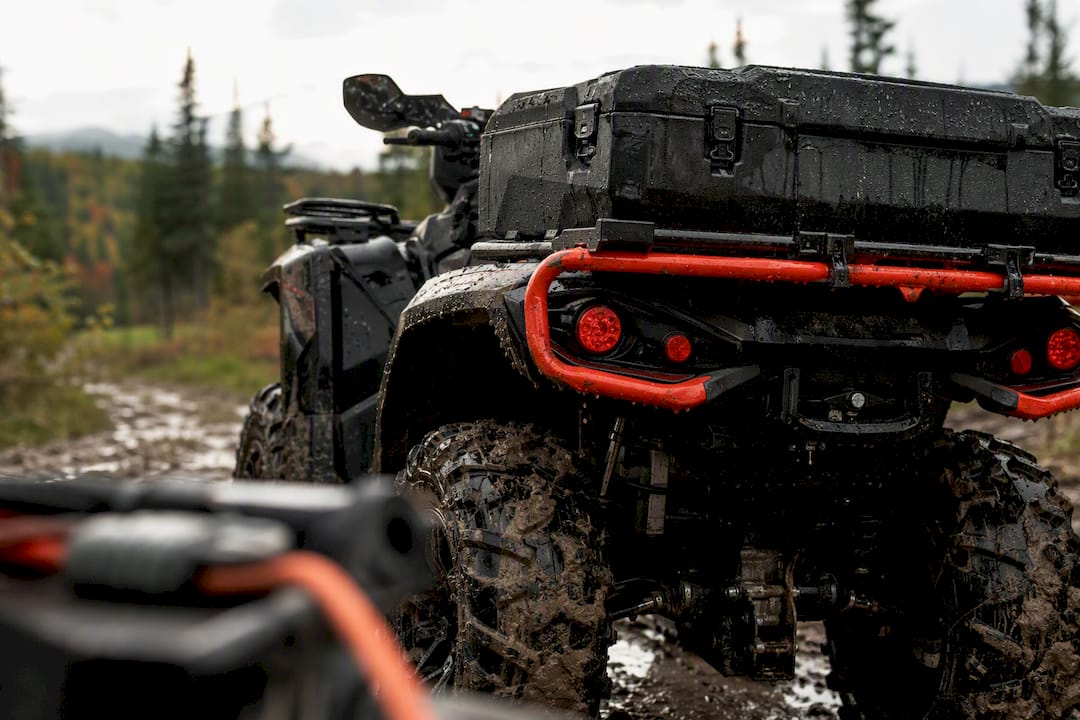
Mud creates suction that resists the initial break-free moment far more than a flat gravel pull. Steep angles reduce the winch’s mechanical advantage, meaning the motor works harder for the same result. Repeated recoveries, like pulling a plow blade dozens of times through a driveway, generate heat and wear inside the motor and gearbox that a single occasional pull never produces.
Accessories add real weight, too. Racks, gear, and plow setups typically add 100 to 300 lb to your working total, and that number should factor directly into your sizing math, not get ignored as an afterthought.
- Front or rear racks loaded with gear: +50–150 lb
- Plow blade and mount hardware: +100–250 lb
- Larger tire and wheel upgrades: +20–60 lb
- Winch and mounting plate itself: +40–80 lb
Pro Tip: If you plow snow regularly, size toward the top of your recommended range or one step up. Repeated lifting cycles generate cumulative heat that a winch rated at the bare minimum wasn’t built to handle season after season.
Synthetic Rope vs. Steel Cable: Which Should You Choose?
The rope on your winch matters almost as much as the capacity number. Synthetic rope weighs dramatically less than steel cable of similar diameter, roughly 1.7 lb per 100 feet for a typical 3/8 inch synthetic line versus about 24 lb per 100 feet for steel. That weight difference matters more than it sounds.
Lighter rope means less strain on your front axle and far easier handling when you’re manually pulling out line in the field. It also stores less kinetic energy if it fails, which improves the safety profile of a snap compared to steel cable.
- Synthetic rope: lighter, safer under failure, easier to handle, but vulnerable to UV and abrasion without a protective sleeve.
- Steel cable: heavier, cheaper upfront, and more resistant to sharp rocks and abrasive terrain, but riskier if it kinks or frays.
Riders who handle rope frequently, or who worry about front-end weight on smaller ATVs, generally do better with synthetic. If you’re winching across sharp rock or gravel constantly, steel’s abrasion resistance can justify the extra weight and cost. Either way, inspect the line regularly and use a protective sleeve on synthetic rope near the fairlead.
Battery, Wiring, and Mounting: What Actually Limits Your Pull
A winch is only as strong as the system feeding it. Undersized wiring or a weak battery will bottleneck even a properly sized winch, causing sluggish pulls and premature motor wear.
Use the gauge wiring recommended by your winch manufacturer, and never extend factory leads with thinner cable to save a few dollars. Your battery needs enough cold-cranking amps to handle sustained draw during a pull, not just engine starts.
Mounting matters just as much as electrical capacity:
- Install on a rated winch plate or bumper, never a fabricated mount without a load rating.
- Align the fairlead so the rope feeds straight onto the drum, reducing side-loading and uneven wear.
- Choose a planetary gearbox design for better durability under repeated pulls and a longer duty cycle.
- Confirm your motor is sealed or waterproof rated if you ride in snow, mud, or water crossings regularly.
Safety Steps Every Winch User Should Follow
A properly sized winch still needs proper handling. Most winch injuries come from avoidable habits, not equipment failure.
- Always use a winch damper on the line, regardless of whether you’re running synthetic or steel. It absorbs snap-back energy if the line fails under tension.
- Keep everyone clear of the line’s path while it’s under load. A snapped cable or rope travels fast and carries real force.
- Inspect the rope or cable, hook, and drum before every use. Replace anything frayed, kinked, or damaged before your next pull.
- Wear rated gloves when handling synthetic or steel line to avoid cuts and burns.
- Inspect monthly during active riding season and schedule an annual load test to confirm the winch still performs at its rated capacity.
That damper step is worth repeating on its own: it’s a simple, low-cost accessory that meaningfully reduces the danger if a line ever fails mid pull.
Where Dirty Birdy Powersports Fits Into Your Winch Decision
Dirtybirdypowersports has built its reputation on straight answers and fair pricing, not upsells. That approach extends directly to winch sizing conversations with riders across Canada.
- Over 200 successful vehicle deliveries and a 5.0 Google rating built on transparent, no-markup pricing.
- Staffed by riders who use the machines and accessories they sell, not just people reading spec sheets.
- Nationwide delivery paired with local, in-person installation support out of Squamish, BC.
For riders who land in the higher-capacity range, Dirtybirdypowersports carries the KFI AS-50WX 5000LB Assault Series Winch for heavy utility and plow work, and the KFI AS-50X Assault Series Winch as a strong mid-to-upper capacity option. Both are available to view and order directly, and the team can walk you through mounting compatibility for your specific ATV before you buy.
Editorial Take: Why Most Sizing Advice Oversimplifies the Decision
Most winch guides hand you a single number and call it done. That misses the point entirely. The 1.5–2× rule only works if you’re honest about your working weight, not the number stamped on a spec sheet from the factory floor.
Canadian riders in particular get shortchanged by generic advice. A machine that plows snow all winter and hauls a rack full of gear in summer isn’t the same load profile as a trail-only weekend rider, even if they bought the identical ATV. The conventional wisdom treats winch sizing as a one-time engine-based lookup. It should be treated as an ongoing question tied to how you actually use the machine season to season.
If you take one thing from this guide, prioritize honesty about your real conditions over chasing the cheapest capacity that technically covers your dry weight. Mud, plow duty, and repeated pulls punish undersized winches faster than most riders expect. When in doubt, size up one notch and protect your line with a damper every single time.
— Dirty
Sources
- What Size Winch for an ATV? - Trail, Mud & Snow Plowing Guide
- How to Choose a Winch for an ATV? Complete ATV & UTV Guide | HUSAR Winch
- Synthetic vs Steel Winch Rope: Pros, Cons, and When to Switch - CargoRigging
- Winch damper product guidance — Sherpa 4x4 (Canada)